Showing posts with label autism. Show all posts

Saturday, 17 August 2013

Genetics Advances and Learning Disability: A Parent's Perspective

My book Bringing Up a Challenging Child.....http://www.jkp.com/catalogue/book/9781853028748 was published in 2000 and takes the reader through Chrissy's life up to the age of 14.

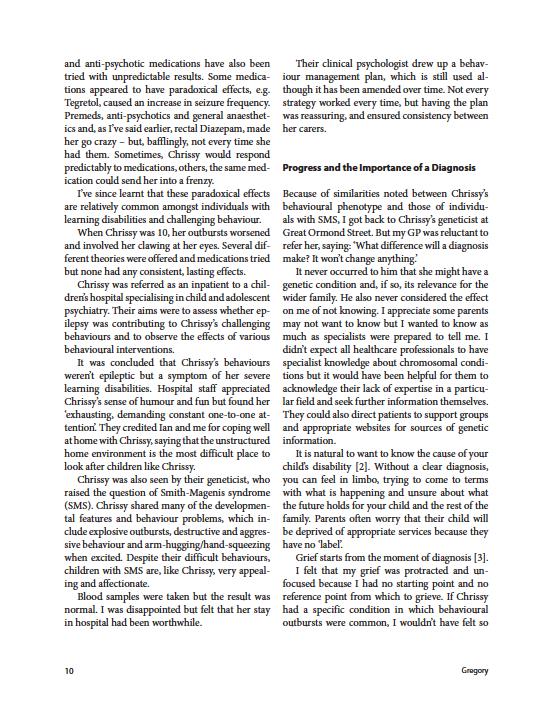
A decade later my chapter 'A Parent's Perspective' was published in the New England Journal of Medicine. Dr Samantha Knight, who was on the research team that discovered Chrissy's chromosome disorder, was editing the journal and, as you can imagine, it was a huge honour to be invited to contribute. The book, which was published in Feb 2010, had the fabulously un-pc title 'Genetics of Mental Retardation' (a term that is still used in the US) http://www.amazon.co.uk/Genetics-Mental-Retardation-Encompassing-Intellectual/dp/3805592809 My chapter encompasses Chrissy's life up to the age of 26, and lies behind reviews on the remarkable advances in modern technologies that have resulted in newly identified syndromes and the importance of genetics in learning disability. The best way I could think of to add my chapter was in a series of images that can be opened up and read individually. The 14 pages can be clicked on and scrolled through at the bottom of the screen.


In between the two books I also wrote a piece for the Daily Mail about the groundbreaking genetic breakthrough that ended our 22 year search for answers in 2006.


I support Unique http://www.rarechromo.co.uk/html/home.asp & I'm a SWAN (syndromes without a name) blogger
SWAN UK

Wednesday, 31 July 2013

Being Chrissy's mum


A beautiful day...

But behind the scenes, I'm struggling with feelings of sadness and loss. We were so thrilled to get Chrissy back at the end of last year - to see the return of her zest for life and her enthusiasm for doing jigsaw puzzles, to take her on holiday, out with family, and shopping for new shoes, her grandma's reaction when we took her up north to visit her for the first time in years.....

Now, Chrissy's slipped away from us again and I'm gripped by the green-eyed monster whenever I see or hear about other adults with learning disabilities going out with their parents. It's routine for many such families but for us, outings and holidays with Chrissy are rare and precious events, often fraught with drama, to be celebrated when they go well. Chrissy just can't manage them at the moment and I realise that we're running out of treatment options. Her epilepsy no longer responds to monotherapy and nearly every secondary antiepileptic drug out there has been tried. She is so acutely sensitive to the neurological mayhem these drugs can cause that they stop her living her life. She isn't complying with bathing, teeth-cleaning etc and is still refusing food. Mood swings continue to be marked - one minute smiling and calm, the next screaming and shouting. She is disrobing on the unit but we haven't seen this at home - just shoes and socks off. She has bruises all over her body again from self-injurious behaviour - the only way she can express her distress. Two weeks ago I'd noticed bruising on her neck & had to raise my concerns at a higher level. I've never seen bruising there before & we're now awaiting the outcome of further investigations into how & when it happened. The explanation I got was too vague for comfort.

The weekend before last when that picture was taken Chrissy was so excited to see her brother, Jamie. His girlfriend, Penny, looks a bit like her sister, Alex. Chrissy thought she WAS Alex - & not just fleetingly. When Alex herself turned up later, Jamie and Penny had left. Chrissy transferred the name seamlessly to the real Alex. I'm uneasy about her confusion. She's always known who close family are even if she forgets other people's names. Another point to mention to her neurologist on Thursday when her antiepileptics are reviewed. The deterioration in Chrissy's health & mental state is something that he will be trying to resolve. The unit has no epilepsy specialists - the neurologist is based at a local NHS hospital. There's nothing more the unit can do for her now and, given the current situation, it's detrimental for her to stay there. So why is she still there?

Some of the housing barriers we've faced have shifted but new ones have popped up. We made a successful bid on a council house in the village but, although we were never given the chance to view it inside, we went with the professionals' views that it was unsuitable due to a number of safety issues in relation to where it was situated and the internal layout. The more housing options we consider the clearer we are about non-negotiables but it's hard to keep having your hopes raised only to have them dashed again. There are very few houses that become available in this area but Chrissy still has priority banding so I will keep checking the social housing website. The other option that's starting to look promising is shared ownership. A specialist housing association has finally come on board and we're having discussions about a house for sale nearby that meets their budgetary requirements. They are concerned about the noise impact on neighbours from any house with a party wall, even with sound-proofing, but a detached property is out of the question due to cost. The noise/disruption to neighbours issue must be a common theme with most people being moved out of assessment and treatment units into supported living and the Winterbourne View Joint Improvement Programme needs to address this.

The tendering process for providing the care package is also moving painfully slowly. I know we'll get there eventually but Chrissy has now spent 3 1/2 years in a locked ward. "What must it be like for her?" I asked Ian recently in a tearful moment. "We'll never know," he said. "You try to put yourself in her shoes but you can't see it like she does and there's no point even speculating."

He's right of course and I need to get a grip - but what mum wouldn't feel like I do? My heart is always at war with my head. I long to kidnap Chrissy and bring her home but I know the situation would be unmanageable, and certainly not in her best interests.

Last week Alex asked: "Do you ever resent Chrissy?"

"No," I answered as honestly as I could. "None of this is her fault. It's the situation I resent."

Reflecting on this question today I can recall times when I've felt fiercely resentful, but only in passing, the same way that I resent Ian when he keeps does something infuriating no matter how many times I ask him not to - like dumping his work briefcase on the kitchen floor!

Alex has just started work as a tutor at a unique school for children with autism, using ABA (Applied Behaviour Analysis) http://www.ambitiousaboutautism.org.uk/page/treehouse_school/teachingandlearning/aba.cfm She's very excited about this new opportunity. She has always felt helpless in the face of Chrissy's suffering, even as a small child. Now she feels able to channel her conflicting emotions, and to use her valuable family experiences and training as a psychologist and teacher to improve the lives of other young people who struggle with autism and learning disabilities. Perhaps we can, in consultation with Chrissy's support team, try some ABA strategies once she moves into supported living.

Naively perhaps, I'd once hoped that similar autism-specific approaches would be used in assessment & treatment units & residential homes that claim to specialise in autism. Maybe one day.....


I support Unique http://www.rarechromo.co.uk/html/home.asp & I'm a SWAN (syndromes without a name) blogger
SWAN UK

Friday, 12 July 2013

Community Care Magazine: The Endless Search for Suitable Housing for My Daughter with Learning Disablities

Community Care, the online magazine for social workers & care professionals, got in touch to ask me to write a piece for them based on my post about barriers to moving Chrissy into appropriate housing in the community. Here's the link. Hope you like it!

http://www.communitycare.co.uk/articles/05/07/2013/119308/the-endless-search-for-suitable-housing-for-my-daughter-with-learning-disabilities.htm


I support Unique http://www.rarechromo.co.uk/html/home.asp & I'm a SWAN (syndromes without a name) blogger
SWAN UK

Monday, 27 May 2013

Frontline Care and Funding Wars

Earlier this year, in our search to uncover the truth behind the ongoing funding dispute over Chrissy's care, I made an official subject access request to view her records.

Two weeks ago we received three big boxes full of paperwork. For several days, each time I walked past them, I eyed them nervously, knowing that once I ripped the first box open I wouldn't be able to rest until I'd gone through the lot...

A week ago on Friday, when I pulled out the first jumble of papers, I was lost. I crouched over them for so long my whole body seized up. When I glanced up at the clock five hours later it was midday and I was still in my dressing gown. I pressed on. A fractured ankle in 2007 from banging her heels on a hard surface; a safeguarding alert where she'd wrongly been given Lorazepam by a trained nurse 'just in case;' an optician receipt - Chrissy had broken her carer's glasses by hitting her in the face. There were many similar incidents recorded from 2007 onwards. I spent the next four days reading the records, scanning in the ones that were relevant to our legal challenge and crying my eyes out.

I'd been made aware of all major safeguarding issues but I was stunned by the level of aggression that Chrissy had displayed towards carers and women she'd lived with. Maybe it had been underplayed so as not to upset me? We get the occasional smack at home but we can normally tell when it's coming and keep a safe distance. If we do get in the firing line the smacks rarely hurt as they lack power or aim. The point is - why had Chrissy (who has the intellectual functioning of a two-year old) been put in a position where she could keep doing this to herself and other people, and what did these behaviours say about her level of distress?

The documentation reveals that Chrissy's carers had struggled to get help from Chrissy's GP and psychiatrist and how they had been left to cope alone with insufficient support. I could see the impossible situation that they'd been put in, the high risk that Chrissy's challenging behaviour posed to herself and others, and why they had been forced to evict her. I read on to a report that described how some of Chrissy's carers were frightened of her and found her so exhausting that they couldn't work consecutive shifts with her. It was even implied in a carefully worded way that some carers had left because of Chrissy.

There's no doubt that Chrissy can be extremely challenging but she can be a delight too and has had a positive impact on many people's lives. It's clear that several of her long-term carers have become attached to her and been profoundly affected by meeting her. Over the years they've commiserated with me over how difficult her life can be but have also told me about happy times they've shared.

Last week, I had a chat with a lady who used to work with Chrissy before she went into hospital. She said: 'Chrissy’s such an amazing person and will always have a place in my heart… It was by working with Chrissy that I knew I had chosen the right career.....so challenging at times but so much more rewarding and satisfying by achieving the smallest of tasks. Please give her a hug from me…'

Later that day a nurse on Chrissy's ward described her in similarly warm terms. 'She's had us all in stitches with her hilarious comments....' she recalled. 'She's got such a fantastic sense of humour!'

One thing's for sure, no one forgets Chrissy once they've met her! Her challenging behaviours can be relentless and very distressing to witness but it crucified me to see her described as someone to be feared.

On the positive side - we got what we wanted from the records. We've uncovered extremely damning evidence that shows what was going on behind the scenes of the funding dispute. We knew that the PCT's 'if Chrissy was in a different 'autism-friendly' environment these behaviours would not occur' argument had failed because it could not be supported legally. Their second argument was even weaker. They acknowledged that Chrissy had had a recognised healthcare need before moving into the area BUT they refused to fund it on the basis that it was a pre-existing need. They were then told BY THEIR OWN SOLICITOR that this did not accord with NHS guidance so instead of coming clean and accepting responsibility, they came up with further ploys to dodge funding responsibility, including trying to pass the buck to two other PCTs. With the pre-existing healthcare needs argument they'd shot themselves in the foot by stating that Chrissy had healthcare needs before she moved into the area. In that case, shouldn't she have been eligible for continuing healthcare funding way before the local authority first applied for it in 2008?

The information we found explains a bizarre reason that Chrissy's psychiatrist gave for refusing to come out when a care home manager phoned her for help - because 'these behaviours aren't new.' Since their arguments to deny CHC funding failed legally the PCT have tried every other trick in the book to stall things. We don't see how they can wriggle out of this now and want an independent review. We will not rest until those responsible are named and shamed. We're appalled by what we've uncovered and how many people, including trained medical professionals, were party to this scandal. We acknowledge that Chrissy is extremely complex and needs high cost support but that's no excuse. We will never forget how funding issues exacerbated her suffering over a prolonged period. If we hadn't fought every inch of the way, God knows how this would have ended.

None of us should forget the wider implications of Chrissy's case - there must be other vulnerable adults, who don't have anyone to fight for them, suffering at the hands of unscrupulous NHS trusts.....


I support Unique http://www.rarechromo.co.uk/html/home.asp & I'm a SWAN (syndromes without a name) blogger
SWAN UK

Saturday, 27 April 2013

Living with a Rare Chromosome Disorder


Well....Chrissy's clinicians have deemed her ready for discharge now, just as I was beginning to wonder whether I was kidding myself to think that her behaviour and epilepsy would ever be stable again.

Since the last meds change several weeks ago, every day has been a sunshine day. We're almost at the optimum therapeutic dose of Zonisamide, at which point the stop-gap antiepileptic, Clobazam, will gradually be withdrawn.

It's heartwarming to see 'no seizures' and 'no challenging behaviours' recorded each day in Chrissy's ward/home report. The episodes of inconsolable distress have vanished. Music from her Ipad makes her dance in her chair and her cheeky chuckles ring out around the house. I took the photo above when we were sitting in my car and she had just reached across to stroke my arm lovingly. Simple gestures like that mean the world to me as Chrissy doesn't often instigate affection.

She is having a great time exploring the new ipad she got for her 29th birthday, doing puzzles, building snowmen and causing mayhem in her virtual home. At first she used different fingers and even changed hands to manipulate objects around the screen - but she's learning fast. She has relatively good manual dexterity and loves anything to do with computers.

On our morning walk to the village shop, Chrissy pointed out sights that interested her, including a metal arch over someone’s gate. 'Rainbow!' she cooed, then stood admiring it for a while. I was enchanted.

Chrissy admiring the 'rainbow'
Chrissy still struggles with transitions and needs all our attention but she's content and responsive, which makes our job much more rewarding. She wants to be out there living her life now. The unit do their best, and do take her out, but not as often as she would like. This morning when I asked her to take her medication, she replied: 'When the night staff come!' It's definitely time for her to move on but we've had to involve solicitors to focus commissioners' minds as things were dragging on. This has been the case with each of Chrissy's major transitions over the past few years. Legal aid cuts are brutal but, in this instance, Chrissy's solicitors were able to demonstrate that we had exhausted every other avenue and only turned to them as a last resort. She will, however, have to pay a contribution.

Chrissy's housing options are still unclear but we are finding a way through the maze. One of the biggest barriers we faced was accessing social housing. I was advised to bid on local homes by Chrissy's commissioners but after several bizarre 'admin errors,' a housing officer said that Chrissy wasn't 'well-placed' for general purpose social housing as she was 'unlikely to be thrown out onto the street.' If someone without a learning disability is at the point of discharge from hospital they would be moved to a priority banding..... The very few adapted properties that I've seen on the website are for the elderly only and, although Chrissy moves slowly and cautiously, she doesn't need adaptations for limited mobility. I then learned that there was a supported living panel at our local CC, which we had not been told about. Our local council's policy documents state that social housing for vulnerable adults and those with a learning disability are their priority. This hasn't been our experience and we've put in a Freedom of Information request to identify how many people with a learning disability have been offered social housing in the CC's area over the past year.

We've also made a mortgage application on Chrissy's behalf, which would be paid for from her benefits, and we're still exploring shared ownership schemes through registered social landlords. I had been left to deal with all this confusing information but now I've had enough and forward emails to the commissioners to deal with.

Chrissy finally has a social worker! Perhaps the long-awaited community care assessment will be done now. She must surely benefit from Social Services and NHS commissioners working together but why has it taken so long when the planning process has already taken place?

So, I'm still fighting to get Chrissy an appropriate care and housing package in the community, but the sting has gone out of it because she is so settled and content. This stability was only achieved by her spending time in an assessment and treatment unit and, in our view, the Government's knee-jerk reaction after Winterbourne to close down such units is misguided and dangerous. There's no doubt that big changes needed to be made, not least for assessment and treatment units to live up to their name - to assess and treat their patients - but we have much to thank Chrissy's unit for. They've brought her back to us.

I support Unique http://www.rarechromo.co.uk/html/home.asp & I'm a SWAN blogger
SWAN UK


Sunday, 17 March 2013

What Price Integration?


Alone in a crowd - with Team GB (Genetic Blip)

Thirty years after the drive to move people with learning disabilities out of austere, Victorian long-stay hospitals back into the community, could they once again, be victims of Government ideology gone too far?

A definition of supported living is 'persons with disabilities living where and with whom they want, for as long as they want, with the ongoing support needed to sustain that choice.' Nearly every Government policy supports the principles behind it but, as I've blogged previously, recent spending cuts and policy changes are blocking us at every turn. http://jgregorysharingsstories.blogspot.co.uk/2013/02/barriers-to-successful-care-in-community.html

The first supported living option we were shown was a bungalow in a cluster of three. I liked the secluded setting but, as it was too far from Chrissy's family home, I asked if there was anything similar nearer us. I was told: "Oh no, this is a one off; it was converted into three bungalows from one residential home. Ordinarily, we would never put three homes for people with a learning disability together like this as it stigmatises them, and makes them stand out in their local community."

I get the theory behind integration but, in practice, does it always work within the bigger framework of a person's needs? If Chrissy could speak for herself, I believe she'd say that her community needs to be small and contained, with lots of structure and routine, around people she knows that cherish her and accept her as she is and treat her with dignity. Chrissy's moods and health are balanced on a knife-edge. By her very nature, she segregates herself. Sometimes she loves to socialise and at other times she truly is alone in a crowd. So what would living in the wider community offer her that a smaller more secluded community couldn't? The big unpredictable space teeming with faces, sights, sounds and multiple choices that we call 'The Community' is anathema for many people with severe autism.

Last week I spoke to a parent who'd achieved my dream of having her child in a supported living setting close to her home. Prior to this, her son's complex/challenging needs had led to residential placement breakdowns - as Chrissy's had. When he'd first moved into the same street as his family, she'd told me 'it's as good as it gets.' It became the ideal I strove for and I wanted to know how she'd achieved it, but after hearing what she had to say I'm thinking: 'should I be careful what I wish for?'

"Jane, our kids are too 'special' for supported living and would be safer, and have a better life on a campus-like set-up - similar to where Chrissy is now but more of a little community," she said. "Like a retirement village but for people with learning disabilities and complex needs. As their challenging behaviour can be very disruptive to others they share with, they could live in their own home in the village, and there would be communal areas with other things going on that they could access if they chose to. They would each have their own staff team but back-up would be on hand."

Of course the wider community would be accessible too but sometimes it's in our children's best interests to keep them within certain confines to ensure their safety and maintain their dignity. Unfortunately, these core and cluster housing models are few and far between. The small rural community-based setting that she was describing sounds similar to St Elizabeth's School, which one of the children in 'Born to Be Different' attended http://www.channel4.com/programmes/born-to-be-different Chrissy, who'd been a termly boarder from the age of 14, and had been so happy there. It was geared up to the needs of its complex little pupils, and even had its own medical team to monitor their epilepsy. Specialists from top hospitals, like Great Ormond Street, routinely visited St Elizabeth's to see patients. It meant we no longer had to put Chrissy through the ordeal of attending hospital appointments in London.

The parent I spoke to explained why a similar setting, albeit one with single core residences, would be better for her son than the community-based set-up he's in now.

"He doesn't see the community like we do," she said. "He has a thing about paper and, if he spots a sweet wrapper or something blowing in the road, he will chase it, oblivious to the danger posed by passing cars. As he's a grown man, it's impossible to stop him once his mind is set on something. He has destroyed countless washing machines in his home because he's obsessed with taking them apart, and he's chucked stuff over the fence into his neighbour's garden because he can't stand the noise from her small children."

As we'd had difficulties in the past with community-based medical support from a learning disability team I asked what her experiences had been.

"Someone in the team keeps going off on long-term sick leave, so there's no continuity of care in one key area and we've had a battle to get a good psychologist. Support workers have felt abandoned and isolated because they haven't been given adequate back-up."


So can supported living work for all people with learning disabilities, even those with the most complex/challenging needs?

The prevailing ethos is that, with the right 'person-centred, flexible, bespoke support package' in place, it can. And if such an alluring support package does become available for Chrissy during these times of austerity? Well, I guess we'll have to wait and see...

I support Unique http://www.rarechromo.co.uk/html/home.asp & I'm a SWAN blogger
SWAN UK

Wednesday, 13 February 2013

Living with a Rare Chromosome Disorder: Support from Other Parents


Team GB (Genetic Blip) members in Hampshire

I feel very lucky to have met some lovely people through Unique, the rare chromosome disorder support group. We meet at each other's houses about once a month. Monday's meetup at Laura's was the first time Chrissy had joined us, and it was a resounding success!

We're quite a diverse bunch. Our ages range from 27 to 52 and our affected children's from 3 to 28. We have a gran who comes along when she can & of course my child is now an adult. Although I used to attend a support group for parents of children with learning disabilities when Chrissy was little, it is a great comfort now to feel a common bond with other parents who know what it's like to have a child with a rare and complex medical condition.

We now have four different rare chromosome disorders among the children in our group.

Chrissy and Faith, aged 6 1/2, have a 1q21.1 microdeletion - http://www.rarechromo.org/information/Chromosome%20%201/1q21.1%20Microdeletions%20FTNP.pdf Last October Unique reported only 64 confirmed cases - so quite remarkable that Faith's mum Jo and her family only live about 20 miles from us.

Sue's 4 1/2-year old daughter, Celyn, has a 6q 26 -6q27 deletion http://www.rarechromo.org/information/Chromosome%20%206/6q%20deletions%20from%206q26%20and%206q27%20FTNW.pdf

Laura's daughter, Katey, aged 3 1/2, has a 15q11.2 microdeletion http://www.rarechromo.org/information/Chromosome%2015/15q11%202%20microdeletions%20FTNW.pdf

Mandy's 4-year old son, Harry, has XXYY Syndrome http://xxyysyndrome.org/english.php

Despite the different chromosomes that are affected, our children share striking similarities, such as feeding difficulties as babies, low muscle tone, developmental delays and behavioural problems, but there may also be wide variations between people with the same chromosomal make-up. For example Faith doesn't have learning disabilities like Chrissy but she shares some of the behavioural traits and health problems, such as repeated ear infections. So although our daughters share some of the traits that tend to occur more frequently in people with 1q21.1 microdeletion, they are also shaped by their own unique mixture of genes and environment. No one knows why certain chromosomal rearrangements cause medical problems in some people but leave other people healthy. Even the features of Down's Syndrome, the most common genetic cause of learning disabilities, vary widely. Current research proposes that there is no syndromic pattern present in 1q21.1 microdeletion but parents I've met online report many common characteristics that aren't documented in medical literature.

It's only over the past 20 years that major advances in technology have demonstrated the importance of genetics, particularly where there is an extra piece of DNA (duplication) or if a bit is missing (deletion). Some chromosome disorders are incompatible with life and will cause the death of the embryo before birth, others can result in effects, such as learning disabilities or short stature that only become obvious as the child develops. Chrissy's deletion is de novo (brand-new); nothing was found in mine or her dad's DNA sample so our children are unlikely to have a child like Chrissy. Some children inherit the chromosome anomaly from a parent who's a 'silent carrier.' The parent may only discover that they have a chromosome anomaly when they undergo genetic tests to try to determine a cause for unexplained health or developmental problems in their child.

Although the completion of the Human Genome Project was celebrated in April 2003, the exact number of genes encoded in the genome and their function is still a work in progress. Our children's genetic blips place them in the forefront of groundbreaking research into solving one of life's greatest mysteries - what makes us human?


I support Unique http://www.rarechromo.co.uk/html/home.asp and I am a SWAN UK (Syndromes without a Name) blogger
MyButton

Wednesday, 26 December 2012

Christmas 2012


This photo sums up Christmas Day for Chrissy. I've had a stinking cold for over two weeks now & dreaded Chrissy getting it as I knew she'd find it hard to cope. She can't blow her nose or deal with all the discomfort.

On Saturday she was complaining 'I feel sick' and by Sunday her nose was streaming. She was also lashing out at us randomly. One minute she was sitting quite happily the next taking a swipe at whoever was closest. At one stage she leaned in towards me. I waited expectantly for a kiss but Ian suddenly pulled her back. 'Her teeth were bared - she was going to bite you,' he said. The level and nature of her aggression is out of character & it's so random. Is it a side-effect of Keppra, the new antiepileptic that was introduced last week, or is it because she feels such discomfort from her cold?

On Christmas Day she was very squawky and unsettled - we were walking on eggshells from the off. We were spending the day with my sister, Sarah, & her family in Bovingdon, Herts, an hour-and-a-half's drive away. Ian drove Chrissy and I kept Alex company in her car as she'd planned to go off afterwards to see friends in the area. Halfway there, I got a call from Ian to say Chrissy had been undoing her seat belt & trying to open the car door on the M25. We hadn't seen those risky behaviours in the car for some time.

It didn't bode well.

My sister and her family did a sterling job entertaining us for Christmas dinner, considering that they too, had been ill with colds. Like us, they had considered cancelling but we all made a valiant effort to eat, drink & be merry - as you do!

We'd last joined them there for Christmas in 2010, when Chrissy had spent most of the day in various states of undress & distress on the kitchen floor. Although, two years on, it wasn't that bad, neither was it quite the rosy vision I'd pictured - of Chrissy mingling happily with her cousins & making us laugh with her quirky sayings & antics.....

Instead, Chrissy alternated between sprawling half-comatose on the sofa, moaning & screeching, swearing like a navvy, farting like a trooper, bellowing Diva-like demands, & randomly slapping Ian in the face. She refused to go to bed &, despite looking like death, still managed to stuff her face.

At the end of the day, I was feeling pretty rough myself & longed for my own bed. We were supposed to be staying at Chrissy's nana's nearby but, as I hadn't been drinking, I decided to dose myself & Chrissy up with Paracetamol & drive home.

Chrissy had other ideas.

She lay down in the far corner of the kitchen & refused to budge for a good hour or so. Ian & I tried shameless bribery with such irresistible treats as 'banana-in-a-bag-tied-with-a-bow' but she wasn't having any of it, & screamed 'go away!' whenever we came near. In the end she got up when she was good and ready. Then, because she's been struggling so much with transitions - another behaviour that's recently returned with a vengeance - we had to woo her with every cunning strategy we could muster into the car. There were huge sighs of relief all round when we finally belted her up.

During the journey home she didn't utter a word other than to ask for tissues during a sneezing fit. When we got home she kicked off as soon as we walked in the door. Cushions and shoes were thrown across the kitchen, then eventually Ian got her up to her bedroom & half into her pyjamas, when she called a halt to proceedings & threw herself onto her bed, biting & twisting her hands. After a while, I managed to calm her down enough to persuade her to use the toilet. She got halfway there then stopped & sneezed violently. 'I need a bath mummy,' she declared as a wet patch sprouted in her pyjamas.

When I finally got her to bed she insisted that her pillows be turned over several times & her blanket just so but as soon as I turned the light out & left the room there was silence. She slept soundly through the night and beyond.

I felt sad for Chrissy that my sister's family weren't seeing her at her best again. I also felt uncomfortable about inflicting all this on other people on such a special day. My sister's elderly in-laws were there too & it didn't seem fair on them. Everyone was kind & couldn't do enough to make us welcome but I so wished things could be different, just for that day. We have such high expectations of Christmas don't we?

On the drive up I'd spoken to Alex about her mixed feelings towards Chrissy - all the 'why us' moments we grapple with at times, the anger that we're unable to express because Chrissy can't help it. I love her unconditionally because I'm her mum - I make choices as to when she comes home and how her behaviours are managed. Her siblings are relatively powerless. The impact a disabled child with challenging behaviour has on a family can be corrosive & divisive. Sometimes in trying to hold my family together and do my best for everyone I've felt like I'm clinging to a sinking ship but I think we're still afloat....just!


I am a SWAN UK (Syndromes without a Name) blogger
MyButton

Wednesday, 5 December 2012

Catching up & Moving on


The last time we'd taken Chrissy to her step-nan's (pictured) was over five years ago. The four-hour journey had been gruelling with a distraught Chrissy repeatedly undoing her seat belt, and screaming, self-injuring and wedging herself into tight spaces.

Last weekend's journey was very different. Apart from the odd burst of repetitive questions, Chrissy settled down in the front seat next to Ian and was content to watch the world go by. When we stopped off at a service station she never once tried to escape to explore the numerous glittering attractions we saw en route to the Ladies. Unheard of!

When we arrived at her nan's Chrissy rushed inside to greet her, grinning from ear to ear. 'I never thought we'd see her like this again,' her nan said, all teary eyed. 'I thought we'd lost her.'

I welled up too as I watched Chrissy taking everything in. She had seen her nan earlier this year when she'd come to stay with us, and she knew who she was. I'm not sure that she recognised the house though. Then her face lit up again as she spotted her sister, Alex, who had come down from Manchester. We hadn't told Chrissy she'd be there or she would have obsessed about it on the way up.


Chrissy is always thrilled to see her siblings. Normally, unless she sees someone regularly she struggles to remember them but she always knows who her younger brother, Jamie, and little sister, Alex, are. The evening went well but Chrissy ate voraciously. We are always trying to distract her and discourage her from overeating but at times, she constantly demands food.

Her happy mood gradually dissipated on Saturday. This often happens after she's been particularly bingey. Something kept coming over her - we never know what - but she suddenly becomes distressed for no discernible reason, and starts screaming, twisting her hands, bending her fingers back and pulling her hair, then she snaps out of it and gives us a beaming smile.

Another mum posted something on a forum that reminded me how difficult things once were for us, and for many other parents of children that have this rare disorder:

''My son's behavioural issues/outbursts/tantrums have escalated so intensely that we don't know what to do anymore. When he gets upset, which is often and for no reason, he is un-calmable. He is incapable of self-soothing, and literally needs me to physically calm him down, rubbing him, deep breathing - sometimes yelling to snap him out of his ritualistic obsessing. It's more than I can take right now and I'm not sure what to do. He woke last night with such emotionally disturbing tantrums and terrors that both my husband and I were in tears......''

Although this desperate mum's description propelled me back to dark times, it also made me realise how far we've come. Chrissy's behaviour will always present challenges to people that look after her but we attribute recent improvements to her revised meds regime. She's still on Prozac but off all antipsychotics. Her behavioural outbursts rarely escalate, her overall mood is much happier, and we can take her out. She continues to be far more alert and engaged in what's going on around her. Her hilarious, stream-of-consciousness observations are back too, giving away all our best-kept secrets! 'Nanny blue jacket, grey hair!' 'You don't like dogs do you mummy?' she declared to my mortification as her nan's adored border collie entered the room. 'Ian farts sometimes,' was another random pearler she uttered loudly and clearly in front of his family. She also threw in a few 'bastard shits' and a couple of 'fucks' for good measure.

The visit was a success, despite Chrissy's changeable mood, and seeing her pleasure at being around loved ones has helped me to re-evaluate what she needs from a supported living placement. I yearn with every fibre of my being to keep her close by where I can protect her and see her more often - but it's not about my needs as a mum - it has to be about what's best for Chrissy. Her psychiatrist and a housing adviser suggested that she'd be better off living in a nearby town. Good public transport links and local amenities would give her more choice of staff and activities, and she wouldn't keep bumping into me while she was out and about. I believe the benefits of living in a community that she's familiar with far outweigh the benefits that are being advocated for her living elsewhere. Chrissy would lead a more fulfilled life if her home was in a familiar place where she has connections to the local community and people that love and care about her. To gain these connections in an unfamiliar place would be a very forced and difficult process for someone that needs 24-hour care and functions at the level of a toddler. Are we in danger of using the 'one size fits all' approach to supported living that is all too often the reason why residential placements break down?

And if it is agreed that Chrissy should live in our village, will government policies dictate otherwise? The current housing and support system is failing many people with a learning disability, who face a lack of housing options due to welfare reforms and budget cuts. Housing benefit caps make rent unaffordable and, although Chrissy can apply for exemption, many private landlords won't accept tenants on benefits, let alone one with a learning disability. Social housing is also inaccessible in some rural areas with specific local connection eligibility criteria. Chrissy wasn't considered for the newly built affordable housing in the village because other applicants that have lived and worked here for years have a stronger local connection. Our only hope is that a suitable, reasonably priced house will come up for sale and a registered landlord will agree to purchase it, and rent it out to Chrissy, possibly in a shared ownership capacity. Struggling to unravel all the supported living red tape makes you wonder if it's delivering on its promise of offering more choice, control and inclusion.

Here, an excellent report by Mencap explores the barriers to successful independent living arrangements, and suggests a national strategy for housing people with a learning disability.
http://www.mencap.org.uk/download-housing-report


I am a SWAN UK (Syndromes without a Name) blogger
MyButton


Sunday, 25 November 2012

Supported Living: Cutting through the Confusion


A supported living option we viewed

We decided some time ago that it would suit Chrissy best to live on her own in the community, with round-the-clock support to help her achieve as much independence as possible - but the choices are mind-boggling and rules about eligibility criteria keep changing. We are just starting down this road and embarking on another steep learning curve!

Here's some information I've gleaned so far, which I've simplified for my own benefit. I hope it helps any of you going down the same road....

Renting privately doesn't work for many people with learning disabilities as standard tenancy agreements only cover a 6 or 12 month period and the landlord can evict the tenant at short notice. It's also unaffordable as most rents now exceed 'local housing allowance' - a term used to describe the maximum amount of housing benefit payable. Another complicating factor is that many people with learning disabilities may need a two-bed house for a carer to stay overnight, or mobility aid adaptations that a landlord wouldn't be prepared to make.

Private sector lease management bypasses some of the obstacles to renting privately. Here, the landlord lets his property to a third party 'Not for Profit' or Registered housing provider that only sublets to disabled tenants. Golden Lane offer a service like this and are affiliated to MENCAP, who would provide the care. Under a private sector leasing arrangement like this, Chrissy's housing benefit claim could then be assessed as exempt accommodation or an excluded tenancy - which means her claim would be excluded from the ordinary rules that cap housing benefit.

In most cases, the only way Chrissy could apply for exemption is if the landlord, or someone acting on his behalf, was prepared to offer a certain amount of care, support or supervision. If she wanted to rent from a private landlord, and care and supervision was independently and wholly commissioned by Social Services, Chrissy could not claim exemption. However if she rented from a registered social landlord, who would contribute to her care and support (I was advised that the amount of support varies but ordinarily around two hours a week) this would fit the bill for exempt accommodation and allow more flexibility on the amount of housing benefit paid.

The care, support and supervision rule deters most private landlords but you would think that it could work for parents if they could afford to buy their child a property to rent from them. Unfortunately, laws governing families renting to disabled relatives are complex and restrictive. A way around the care, support and supervision rule is for Chrissy to rent from a registered housing association. Because the housing association is already regulated by central government and receiving government subsidies it isn't obliged to provide the care and support and it could come from another source. If the housing association don't have anything available they can do a lease deal or buy something outright for Chrissy on the understanding that she would rent it from them.

Our final option, and the one that interests us most, is shared ownership. Chrissy will be on the high rate of DLA for mobility & care again when she leaves hospital, which means she should be eligible to get a small mortgage to be paid for from her benefits. The top-up amount needed to buy something suitable would be paid for by a registered housing association that runs such schemes. They would do all the repairs and maintenance, and it offers Chrissy the most security as she would be a leaseholder. The main drawback for us is that this route is more lengthy and complicated than most, and Chrissy is due to leave the assessment and treatment unit in the next two months.

If we do opt for shared ownership we may have to look at what could be done to support Chrissy here at home with us during the interim period between her discharge and finding a suitable place to live.

Some time in the future we may move to a different area & buy two houses close together with Chrissy in mind. Where we live now is in the middle of nowhere and I've abandoned the idea of her living in the same village. In order to make the most of her independence she will need to be near a town with access to a wide range of amenities and good local transport routes to offer a better choice of staff.

So far we have been offered one option - our local PCT have a vacant bungalow adjacent to two other homes that are singly occupied by women with learning disabilities. They would all be cared for by the same team. The downside of a commissioner providing both housing and care is that the roles would be harder to split if there was a problem say, the care provision failed but the accommodation was fine. This option looks good on the surface, and the bungalow is in a nice area, but I'm uneasy about putting Chrissy completely in the PCT's hands because they've let her down repeatedly in the past. It's also further away from her family home than is preferable.

Another maze to navigate and a big responsibility resting on our shoulders. We need to get it right this time to give Chrissy the life she deserves.


I am a SWAN UK (Syndromes without a Name) blogger
MyButton

Sunday, 21 October 2012

My Life with Autism: The Supermarket - by Debbie Pollard

Debbie, mum of Matthew, aged 10, kindly agreed to guest post for me this week.


Matthew

When those of us who have autism in our families venture outside it can feel like walking through a minefield. We are only too aware of the danger. We just don't know exactly what will cause the explosion. One wrong step: BOOM!

The constant scrutiny is incidental.

Some of us feel like we are on exhibition every time we leave the house. Always on the brink of becoming some sort of grim public entertainment. There's always someone further down the food chain to feel superior to. Who needs Jeremy Kyle?

Matthew and I head for the front. Today we will enter the hostile territory of the supermarket. A logistical failure has left us without vital supplies. We are lucky enough to get a space in the relative safety of a disabled bay – our journey into the shop should present minimal risk.

Already we are attracting some interest. Well, I have parked in a disabled space and both of us can clearly walk.

Tut-tut. Blue badge nothing. She's no right parking there.

Eyes down. Focus on Matthew. I'm not ready for a staring match and I'm saving my energy for when I most need it.

In we go. I grab a basket as we pass. I don't need a trolley. We won't be buying much and, besides, I can't push a trolley and keep hold of Matthew at the same time. I know he will run, scream or lie down. But when? Where? Why? Well, I'll know when it happens.

We're in. Basket in my left hand, Matthews hand in my right. He's jumping up and down, making noises. His hood is up, providing a little sensory protection.

Why's she letting him do that?

“TOILET”.

It's the three minute warning. Matthew may need the toilet. It may just be a tactic to get away from this environment he has found himself in. This environment that I have brought him into. Either way, the toilet is the next place we are headed.

The disabled toilet is occupied.

“TOILET! TOILET!! TOILET!!!”

Heads whip round.

What a racket. Why doesn't she shush him?

Can a head really turn that fast without doing it's owner an injury? If rubbernecking ever becomes an Olympic sport, Team GB is a shoe-in for gold. Matthew is becoming increasingly agitated. How did it get so hot in here? Sweat trickles down the back of my neck. Ladies it is. We're going in, and it might not be pretty.

Horrible blueish lights in here. To stop people injecting drugs by making their veins hard to see? Energy saving? Just because someone liked them? It doesn't really matter.

Now Matthew's hands are clamped to his ears.

What's that laddie doing? He's too big: should be in the gents.

“DRYER”

“No, it's OK, no-one is using the dryer, on we go”

“DRYER”

“No, it's OK......”

Hand dryers are scary. An assault on the senses. The air pressure changes. Any bits of fluff or paper on the floor are flung around by the turbulence. Lets just hope we can get through this without one going off.

We're in, we are out. Hands washed.

“No, it's OK, Matthew, I'm not going to use the dryer”

He takes no chances though. He's been here before. Experience makes him cautious. Hands over ears, one arm linked through mine, we make our way back into the shop. I'm bent over sideways. Do we look strange? I'm sure we do. I know I'm being watched but I've got work to do.

“Good boy, Matthew, it's OK, we're back in the shop, dryer is gone”

Eh? Why doesn't she just make him walk properly?

Shelves and shelves of things to eat and play with. Trolleys and people coming from every direction. Giant freezers hum. A hundred beeps per minute from the scanners, all slightly out of sync. Chatter. Children crying. Dishes clattering and the faintly unpleasant odour of everything with chips being prepared in the café.

We head deep into the shop. It was cold near the freezers but now it's so hot. Milk. Far from the doors. Deeper and deeper. Avoid the sweetie aisle for now. To throw us, the supermarket changes it's layout now and then. I'm sharp enough to take avoiding action when necessary. Almost there. We're here. Basket on the floor. Matthew by the hand. One, two cartons into the basket. Matthew has held up well so far. Time for him to choose a treat.

I relax a little. Rookie error. Matthew slips his hand from mine and he's off. He has carried out his own visual sweep of his surroundings and spotted something I've missed. He's on it like heat-seeking missile. Packets of sweets at the end of an aisle. Of course. A well known tactic of the supermarket. How could I have forgotten? I thought we were relatively safe.

Some people just can't control their children.

Snap decision. Drop the basket and run? Just run? I choose the latter – damage limitation is all I can do now and keeping hold of the goods will make our escape a little quicker. He's at the sweets. Two packets ripped from their hooks.

Check her running in those boots


Trainers! Kit error. Still, I've caught up with Matthew. To be more accurate he has ripped open a packet of sweets and has stopped to eat them. That packet will be written off. I'll take the empty wrapper to be scanned. There's a chance for the other packet though.

“Matthew, give Mum the sweets”

“Sorry” (a word Matthew uses when anxious or unwilling to co-operate)
I only fight battles that I might win. We could carry on this wee stand off all morning. Or at least until the sweets are all gone. It could escalate until Matthew is lying on the floor screaming and I am on the verge of tears. Nothing can be achieved here.

I don't believe it – she's just letting him keep the sweets. No wonder he's so badly behaved!


Plan A was for Matthew to chose a treat. Well he has chosen it. Plan B. Quickly to the nearest or quietest check out. Avoid the ones with eye-level sweets to tempt Matthew. Damn ingenious supermarket. But at least in this one there are actually some check-outs that are sweet-free. Others are more ruthless and we're not ready to tackle those yet.

Empty check-out. I'm so, so glad. I can see the exit. Milk on the conveyor, Matthew's hand still in mine. He'll not try to give me he slip again – he knows I'm back on full alert. And, anyway, he is contentedly munching his sweets.

“Are you enjoying them sweets? Not talking son?”

Ignorant. And look at her. A smile would crack her face.


“Enjoy the rest of your day!”

“Thank you. You too.”

Got the milk. Got Matthew by the hand. The doors are getting closer. Fresh air, I can almost smell it. Out in the open. Daylight. I can see the car. Safely inside. Engine on. And breathe!

Until next time.


Debbie & Matthew

Debbie wrote this post for Act Now For Autism, formerly known as ACT NOW (Autism Campaigners Together). Act Now For Autism http://autismcampaigners.blogspot.co.uk/ is a core group of people passionate about the future and well-being of children and adults with an Autistic Spectrum Disorder in the UK. Act Now For Autism are campaigning against aspects of Welfare Reform, specifically face-to-face assessments and the Work Programme. They are ardently campaigning for advocacy to be offered to anyone who has to attend a benefit assessment.


I am a SWAN UK (Syndromes without a Name) blogger
MyButton


Saturday, 13 October 2012

Living at Home again: An Impossible Dream?


West Meon Church

A magical morning with Chrissy. We walked to the village shop for a newspaper and Maltesers. Chrissy behaved perfectly so we stopped for a photo-call in the churchyard. Later as we looked through the pictures on her laptop, Chrissy's face was wreathed in smiles as I showed her how to move the cursors around. She giggled as she made herself disappear then re-appear on the screen – now you see me, now you don’t!


Having it all - enjoying lunch, Cbeebies and today's photos!

My last post was about taking a stand. I can reveal now that it was over Chrissy's Quetiapine - I was so desperate for her to come off it that I stopped it for three days on holiday. Then I admitted what I'd done to the ATU and begged them not to re-introduce it as we had seen improvements in Chrissy's behaviour and mood. It was a rash decision on my part and I've explained my rationale on here before. I had no concerns about the risks as we had seen similar improvements when the ATU had 'forgotten' to give Chrissy half the prescribed dose for a fortnight. For reasons I completely understand her doctors reinstated the drug but immediately began to 'review it downwards.’ (They need to monitor effects.) Chrissy is now on only 50mg once a day. So far so good, although her ward nurse told me that Chrissy had been slightly more agitated at meal-times lately, bending her fingers back and asking repetitive questions about food. However, her nurses have been able to distract her.

As the weekend's gone on, Chrissy's had her moments but she's been relatively easy to pacify and fully engaged in everything we've been doing. As a general reflection of her improved mood over recent weeks, her hair is growing back and looking more lustrous (she isn't pulling it out), and her body is no longer marked by self-injury.

Now Chrissy's behaviour has settled down, I’m feeling more torn than ever about her future. We’re no closer to finding a way to set up the bricks and mortar part of the single service unit option (where Chrissy lives on her own with 24-hour support). You've seen from previous posts how some issues that crop up in residential care haunt me. Now I’m wondering again if there's any way we could make it work for Chrissy to live with us permanently.

Ian doesn't believe that living with us would be the best thing for Chrissy. He fears we could go back to square one if her condition were to deteriorate again. As there's every chance, given her history, that this could happen, anything that's put in place would need to be watertight to minimise the risks of further traumatic moves. It may sound selfish but we're in our fifties and enjoying more freedom now that our children have grown up. It would serve no one if we were to go backwards to a time when Chrissy's outbursts ruled our lives and I felt like a prisoner in my own home with her too unsettled to take out or leave with a care-worker. We would be setting ourselves up to fail if we were propelled back into the fray of pointless crisis meetings and battles to get effective medical treatment and support. So there would need to be strong contingency plans in place, for example, an immediate return to the ATU for further assessment and, if necessary, treatment - and how enforceable would those plans be? I’ve lost all faith in Chrissy's commissioners, with their endless broken promises and buck-passing.

Another question is whether we could devote the time, energy and patience to manage Chrissy's needs as they should be managed and, the biggie that terrifies all parents of disabled children - what will happen when we're gone? As one of the provisions for her future care, shouldn't we ensure that she is settled somewhere that doesn't depend on us being around?

Anyway, it’s all hypothetical right now and I may have blogged myself out of it! Ian’s far more pragmatic than me – I follow my heart but as my book title says sometimes ‘love isn’t enough.’ It’s early days and I'm jumping the gun – a date for discharge from the ATU has yet to be agreed. Chrissy's epilepsy is still not as controlled as her doctors would like it to be and if another anti-epileptic drug is trialled she will need to stay in the ATU for further monitoring as she's had such nasty reactions to the last two.

At the next care planning meeting on 22 October I propose that we ask commissioners to suggest a support package template if having Chrissy back home is a route that Ian and I could agree to explore.....

Since I published this post I was given more food for thought when another mum of a child with learning disabilities wrote a piece for the Daily Mail that included her take on the residential care dilemma. She questions whether it would be cruel to leave her daughter unprepared and unprotected when her parents die: http://www.dailymail.co.uk/femail/article-2219305/The-daughter-taught-meaning--love-Lady-Astor-pays-moving-tribute-autistic-little-girl.html


I am a SWAN UK (Syndromes without a Name) blogger
MyButton


Saturday, 29 September 2012

The Holiday where I Took a Stand: Valuing Lives of Adults with Learning Disabilities


Chemically coshed?

We set off for Center Parcs, Longleat, with trepidation and a back-up plan. Our last holiday with Chrissy had taken place over four years ago, and it hadn't gone well. At least Longleat is only an hour or so from our home and the ATU. If it all went belly-up we had the option of taking Chrissy back....

On the first day Chrissy’s behaviour can only be described as ‘monstrous!’ She roared and barked endless demands that we could never satisfy. Her appetite was insatiable too. We ate at Café Rouge as soon as we arrived but the minute Chrissy had cleared her plate, she began obsessing about food again. These behaviours continued at the villa and escalated to outbursts with the usual thrashing around on the floor. Thankfully, the episodes were short-lived and in our own space we could let her get on with it.

‘I’ll never do this again,’ Ian muttered darkly. Eventually, Chrissy sat down with us, but we were still jumpy and tense with her and each other, wondering if we'd made a big mistake to bring her there. Then I heard a soft giggle beside me. When I turned round, Chrissy was smiling and pointing at the objects of her amusement – my feet on the coffee table wiggling in time to music on TV. My heart melted. People with autism rarely gesture or point at objects to communicate. Chrissy has started doing this very occasionally, and they are special moments.

The next morning she played up while taking her meds and I had to try again later with her antipsychotic, Quetiapine, and her fish oil supplement. Within around half an hour she looked so drowsy I thought she was going to have a seizure. Here, with more time on my hands, I was able to observe Chrissy more closely & objectively than I do at home. In previous posts I've described my concerns about the clinical need for her to be on Quetiapine or indeed any antipsychotic. I bring it up at every care planning meeting but it never seems to be the right time to trial Chrissy off it - her doctors want to stabilise her epilepsy first (yet antipsychotics lower seizure threshold!) or they want to wait for a more settled period or wait for the next specialist appointment etc. The ATU halved her dose in error several months ago and noted improvements in her behaviour - so why is she still on it nearly three years after I first expressed concerns?

Once we got to Longleat Chrissy kept whingeing, nagging about food, and sitting down and refusing to move on. Just after we entered the African Village, she body-swerved back to a sweet shop we’d passed & surfed the displays for Maltesers.

They’d run out.

Cue Chrissy to throw herself on the floor, where she stayed for around 15 minutes. She lay there quietly, only shrieking when we tried to talk to her or get her back up on her feet. We stood there like lemons until, finally, she got up and selected a pack of fun-sized Kit-Kats that shared the closest resemblance to Maltesers. With the sweets secured in her coat pocket, we were able to continue on our way.

We got stuck again by the meerkats – the first animals we came to. Unlike most people, Chrissy wasn’t impressed by their antics even when six of the endearing creatures stood upright in unison. We accepted that we would be operating on ‘Chrissy-time’ that day. Next, she made a bee-line for Postman Pat Village then plonked herself down on the ground again and threw my sunglasses, which she’d been wearing, to the ground. As so often happens, just as you want to wring her neck Chrissy's mood about-turns. She agreed to a photo opportunity with Postman Pat and was charmed by the inanimate model. It engaged her attention more than any of the animals we’d seen.


On the way to the game park, we stopped at the toilets. Chrissy started shrieking and shouting on the loo and sent the sanitary disposal unit crashing to the floor. We emerged to curious stares then she flung herself to the ground again as a group of school kids filed by, eyeing her warily. Chrissy didn’t react to their presence. As usual, she got up when she was ready and we set off on the drive-through safari. Clutching her empty paper Coca-Cola cup and bag of Kit-Kats like talismans she seemed content enough but showed no interest in the animals.


Wednesday was a better day - we got Chrissy into the pool & spent an hour or so there - but the biggest blip of the holiday occurred that evening at the Pancake House. They had a children’s entertainer on and refused entry to anyone that hadn’t pre-booked. I tried my best to persuade them, but to no avail. Needless to say Chrissy kicked off right outside in full view of the diners. The manager rushed out with a complimentary all-singing-all-dancing pancake, the sight of which sent Chrissy into orbit. She threw herself on the ground screaming, thrashing around and banging her head. To further fan the flames, a man who’d been sitting outside drinking tried to step into her world. He lay down on the ground beside Chrissy and started talking to her. ‘I work with kids like this,’ he slurred to us. ‘They're so lovely.....’

Chrissy smacked him in the face!

I explained that we have to pretend Chrissy is invisible when she goes into these states as any eye contact or attempts to communicate makes things worse. She has to be left to come out of it on her own. The man’s daughter came outside with his grandchild. Gradually, Chrissy became aware that there was a baby nearby and sat up. It was a rapid mood switch even for Chrissy. ‘Is it a baby?’ she twinkled. ‘Can I stroke her?’ We watched nervously as Chrissy softly caressed the baby’s back and chatted away, asking questions like: ‘What’s your name baby?’ It was a stark contrast to the violence of her outburst, and I was pleased for Chrissy that this family had seen her at her best. It was interesting that Chrissy asked the baby: 'Have you stopped crying now? Were you cross?' (signing the word for cross) Ian and I both think that Chrissy was talking about herself in a third-person kind of way.

Chrissy then plonked herself down between us and tucked into her pancake, chatting and giggling with the man, who was definitely the worse for wear but harmless. He kept Chrissy entertained, pretending to nick her food and joking about taking her on a date. After we left Chrissy couldn't stop talking about her new 'friend.' The experience had been quite surreal - but what a happy ending!

Thursday was better still. We managed to get Chrissy on a trike. She let us push her around but didn’t pedal or steer it herself. She used to race around on her own trike but her mobility has decreased with age – she struggles to climb on and off things, and has lost agility, skills and confidence. This deterioration also coincides with her weight increase since the introduction of antipsychotic drugs.....I hasten to add here that the sweets she gets are carefully rationed & the cokes are diet &, where possible, caffeine free, diluted with water. It's about what the packaging represents. Although Chrissy loves to eat she can happily hold on to her favourite branded food items for days.


Later on we transferred our holiday photos to Chrissy’s laptop. She sat entranced flicking through them. Her mood got better and better. We went for an early evening stroll – she walked a total of around two miles that day. Later, she watched the Bear and Father Christmas instead of sticking rigidly to her Snowman DVD. As she watched Father Christmas, she smiled over at us while excitedly tapping his picture on her DVD cover to show they matched. It was a lovely last evening.


The next day Chrissy woke up to an empty villa – everything had been packed away. It struck me that it was like the end of the Snowman DVD where all that remained of the night's magic was his hat & scarf. Chrissy reacted well considering - no nagging for food, and quite compliant given that we had to rush her out of the villa by 10am - but we could tell she was bewildered and disorientated. I felt a huge sense of desolation for her that grew as we drove back to the ATU. The villa had become home. She'd had her favourite things around her, & now they were all gone until her next visit home.

At the ATU she asked for her laptop again. Unfortunately we’ve never been able to get them to agree to keep it there – nowhere safe to store it we’re told. It seems harsh to deny her one of the few things she loves to play with but she has a toy laptop there that’s become another favourite activity. Hoping to distract her, I asked a nurse where it was. She looked at me blankly. I kept on until someone went to search for it and eventually brought it out to us without batteries. How long had it been stored away out of Chrissy's sight because it couldn't be used? Why hadn’t anyone thought to tell us or use her pocket money to buy more batteries? She gets attached to treasured objects like this & has so few of them there. I find this sort of thing beyond upsetting. It symbolises something that I can't bear to think about, let alone put into words for a blog.

While we were unpacking later at home, I couldn't stem a sudden flood of tears. It felt like grief....

Our holiday had highlighted how life is passing Chrissy by while we wait interminably for actions to be taken that will move things forward. A care planning meeting that I'd hoped would lead to progress with some of these actions was postponed by SEVEN weeks because key professionals were on holiday, only worked on certain days or were attending training days. The upshot of it all is that I decided to take the lead on something that has been dragging on for far too long. It could get me into hot water but it's worth it if the end justifies the means....


I am a SWAN UK (Syndromes without a Name) blogger
MyButton

Monday, 3 September 2012

Battle Weary but Making Progress


Chrissy age 9. The start of more turbulent times. Note self-inflicted scratches on face & around eyes

As we continue to marvel over Chrissy's emergence from medication-induced cognitive impairment and behavioural changes, we are looking at her future care options. Although we haven't got a discharge date yet, we're nearing the end of Chrissy's treatment but can't make firm plans until the funding dispute is resolved. A personal support package needs to be in place before Chrissy can take up any housing options that may be offered but despite the efforts of a solicitor, an ombudsman and ourselves, progress is still painfully slow.

A mum that faces similar challenges to ours said she has always tried to take a reasonable approach but feels her constant efforts to improve her disabled child’s life are an uphill battle without any action. Another parent said she was in despair as she doesn’t see any significant changes coming to ensure good, long-term care for her child. ‘I’m sick and tired of all the stress and worry, and the coping,' she says. 'I want to be heard. I’ve had enough.’

Battles can start early on when you have a child with a learning disability, particularly if the cause is unknown or the child has complex needs. My book ‘Bringing Up a Challenging Child at Home’ http://www.jkp.com/catalogue/book/9781853028748 describes my attempts to get someone to take my concerns seriously. No one ever sat me down, and took time to listen and explain anything. I was always asking ‘what’s wrong with my child?’ I felt like I was being fobbed off and became increasingly frustrated.

Eventually, it became chillingly obvious that something was wrong. Chrissy was diagnosed with epilepsy when she was 10 months old and, later, with developmental delay. She received physiotherapy, occupational therapy and speech therapy but these services were snatched away when we moved to a different area. It was our first experience of the postcode lottery but not our last - a decade later Chrissy's respite care allocation was halved when we moved to another county. I didn't know how to go about challenging these decisions but I've since learned that it's only those who shout loudest that get the help their child needs.

During Chrissy’s early school years things went relatively smoothly. She had sufficient support in lessons to help her to achieve her potential and was under the care of Great Ormond Street Hospital, who took quite an interest in her. It was only as she grew bigger and more difficult to manage that the battles began in earnest. Health professionals and Social Services seemed to write Chrissy off & wouldn't offer sufficient support. I guess no one really knew what to do and they feared that they would carry the can if something went wrong.

When Chrissy was nine doctors began prescribing anti-psychotics and sedatives to try to subdue a particularly intense outburst cycle but the episodes escalated and became more violent and prolonged than ever. Over the next four years there was one crisis after another as her SLD school struggled to cope and so did we. We were using behavioural intervention strategies but they only helped with day-to-day challenging behaviours, not with these more severe episodes.

Finally when Chrissy was 14 Ian and I snapped after she'd had several days of frenzied self-injurious outbursts while on the anti-psychotic, Haloperidol. Somehow we got her down to our local children’s ward. 'This is our daughter, Chrissy,' we told an appalled nurse,'and we're not taking her home until someone helps her.’ We had a heated discussion with hospital staff when they realised we were sticking to our guns but once they got a handle on the situation they agreed to help. I’ve described Chrissy’s transformation in just 14 days after those meds changes in previous posts. For the next few years things ran relatively smoothly again - but when her meds were withdrawn after the platelet drop, I was propelled back into the fray.

The dreaded anti-psychotics were re-introduced, and Chrissy's behaviour & quality of life deteriorated again. Her doctors wouldn't accept anti-psychotics were making things worse AGAIN, and argued instead that it was all down to her being in the 'wrong' environment for someone with autism. There were endless disputes over the right course of action to take and Chrissy was stuck in the middle. In 2008 after another awful cycle of extreme outbursts, she was given 28 days' notice of eviction from her residential care home. I fought a legal battle to give us extra time for a transition to another care home, then when that placement broke down amidst the all-too familiar backdrop of medical professionals doing nothing and citing the 'not-fit-for-autism' environment, I had to take legal action again on two separate occasions to get Chrissy into hospital for assessment and treatment.

While parents of neurotypical children face occasional set-tos our battles are never-ending and instead of stopping when they become adults, they get worse. There's always another 'concern' to address along with major ongoing issues rumbling in the background, and we go through periods of reeling from one crisis to another.

In my previous post Groundhog Day http://jgregorysharingsstories.blogspot.co.uk/2011/10/special-saturday-post-groundhog-day.html I describe how I feel like I'm continually revisiting the same issues. For example, last year's admissions and apologies from the NHS trust about making a ‘dog’s dinner’ of Chrissy’s assessments for healthcare funding, and their promises to rectify the situation with properly conducted assessments and thorough investigations have come to nothing. I"ve lost count of how many times my hopes have been raised like this. Another parent described it as like kicking a football around a triangle. You are in the centre of the triangle created by professional services and your issue just gets kicked around from corner to corner as the professionals that you go to for support pass the buck and blame each other. After going down all these frustrating routes of trying to get someone to take responsibility and action you are left back where you started to kick the football from.

Meanwhile, Chrissy's epilepsy remains unstable, and other health worries keep cropping up that leave me feeling acutely aware of the fragile balance between symptom control and quality of life. We intend to make the most of the good times while they last. That's why we're taking Chrissy on holiday to Center Parcs at the end of the month. Wish us luck!


I am a SWAN UK (Syndromes without a Name) blogger
MyButton


Friday, 24 August 2012

Another Outing & Feeling Torn...


Out for Sunday dinner with sister & cousins

Third proper outing in the past month or so. At first we ummed and ahed about whether to take Chrissy with us as she woke up on Sunday in such an unsettled mood. Feeling torn is part of being Chrissy's mum. It's hard to know what to do for the best because she is so unpredictable.

The day got off to a difficult start. Chrissy was shouty & repetitive as I was getting her dressed, she then blundered into Alex's room and woke her up. Result one very stroppy Alex, who'd been up until 4am lesson planning for her new teaching job. 'If you take Chrissy I'm not going,' she announced.

'No, we'll drop her back.' I was hedging my bets. I planned to make up my mind once we got nearer the restaurant. Chrissy's ATU was very close by so we could do a detour if necessary.

On the journey there, Chrissy obsessed non-stop about food. We tried all the tricks, getting her to repeat our answers back: 'What did we say Chrissy?' Signing zip it up & 'yes' instead of giving verbal feedback & so on. Nothing worked but optimism prevailed. We owe it to Chrissy to keep taking chances on her and I banish memories of previous disasters. Onwards and upwards!

Our table was perfectly positioned in its own room. It wasn't completely private - people could walk through it to the garden - but it was a handy escape route for us too! I prayed that sausages, Chrissy's favourite, would be on the menu & that somehow we could get her to wait without kicking off. Ian was a star - he drew sausages, wrote s-a-u-s-a-g-e-s & got her to copy it, & asked Chrissy what she would be eating with her sausages. 'Is it tomato sauce?' 'Is it mashed potatoes and gravy?' A diet coke with two straws and no ice was duly served to Chrissy. She eyed it warily because it wasn't in her usual bottle or cup, and we breathed a sigh of relief when she accepted it, topped up with water, just as she always likes it.

During the wait for food, Chrissy grew increasingly curious about what was going on around her. She introduced herself to her reflection in a mirror on the wall above the table, then, clapping, flapping and talking at the top of her voice, she made her way, like a galleon in full sail, towards the main dining area. There was no stopping her so I grabbed her hand and managed to steer her past the bar and other dinners to the loo, then back again to her seat. People politely pretended not to stare and I politely pretended not to notice.

Ian then managed to divert Chrissy outside and I left him to it. Sometimes Chrissy can be overwhelmed by two people talking to her and directing her. After 10 minutes I went to check everything was ok and found Ian patiently pushing her on a very sturdy swing in the garden. The expression on her face was beatific. She was the most relaxed I'd seen her all day. Another item on the 'shopping list' for Chrissy's new home.


After dinner Chrissy nagged obsessively about pudding. After pudding it was 'I want sandwiches' but we got through it all without mishap and, although Chrissy's mood wasn't as good as it can be, she enjoyed her meal out. As Alex says 'it's like she was about to kick off but somehow she never did.'

Then came the part that tugged at my heartstrings. We took her back to the ATU and her face crumpled. 'I want to come home,' she sobbed. Tasha, a carer she really likes sat with her for a while & managed to distract her with a picture book. Then Chrissy called out 'bye!' to us quite happily.

I was told that she had been crying to come home in the week too. This is another effect of Chrissy waking up after medication changes. She knows all too well what she wants and she's telling us loud and clear. I can't put into words how torn & guilty I feel over this & I wouldn't mind betting that many other mums in my situation feel the same. I rationalise it by telling myself that she's an adult and most people her age live independently anyway but she's like a toddler - so terribly vulnerable; Ian reminds me that one day we'll no longer be around, so she needs to get used to living away from home; I remember how hard it was to let go when I first had to accept that we could no longer cope. It gets easier but the ache never goes away. You just have to find a way to live with it.


I am a SWAN UK (Syndromes without a Name) blogger
MyButton