Showing posts with label unique rare chromosome. Show all posts

Wednesday, 13 February 2013

Living with a Rare Chromosome Disorder: Support from Other Parents


Team GB (Genetic Blip) members in Hampshire

I feel very lucky to have met some lovely people through Unique, the rare chromosome disorder support group. We meet at each other's houses about once a month. Monday's meetup at Laura's was the first time Chrissy had joined us, and it was a resounding success!

We're quite a diverse bunch. Our ages range from 27 to 52 and our affected children's from 3 to 28. We have a gran who comes along when she can & of course my child is now an adult. Although I used to attend a support group for parents of children with learning disabilities when Chrissy was little, it is a great comfort now to feel a common bond with other parents who know what it's like to have a child with a rare and complex medical condition.

We now have four different rare chromosome disorders among the children in our group.

Chrissy and Faith, aged 6 1/2, have a 1q21.1 microdeletion - http://www.rarechromo.org/information/Chromosome%20%201/1q21.1%20Microdeletions%20FTNP.pdf Last October Unique reported only 64 confirmed cases - so quite remarkable that Faith's mum Jo and her family only live about 20 miles from us.

Sue's 4 1/2-year old daughter, Celyn, has a 6q 26 -6q27 deletion http://www.rarechromo.org/information/Chromosome%20%206/6q%20deletions%20from%206q26%20and%206q27%20FTNW.pdf

Laura's daughter, Katey, aged 3 1/2, has a 15q11.2 microdeletion http://www.rarechromo.org/information/Chromosome%2015/15q11%202%20microdeletions%20FTNW.pdf

Mandy's 4-year old son, Harry, has XXYY Syndrome http://xxyysyndrome.org/english.php

Despite the different chromosomes that are affected, our children share striking similarities, such as feeding difficulties as babies, low muscle tone, developmental delays and behavioural problems, but there may also be wide variations between people with the same chromosomal make-up. For example Faith doesn't have learning disabilities like Chrissy but she shares some of the behavioural traits and health problems, such as repeated ear infections. So although our daughters share some of the traits that tend to occur more frequently in people with 1q21.1 microdeletion, they are also shaped by their own unique mixture of genes and environment. No one knows why certain chromosomal rearrangements cause medical problems in some people but leave other people healthy. Even the features of Down's Syndrome, the most common genetic cause of learning disabilities, vary widely. Current research proposes that there is no syndromic pattern present in 1q21.1 microdeletion but parents I've met online report many common characteristics that aren't documented in medical literature.

It's only over the past 20 years that major advances in technology have demonstrated the importance of genetics, particularly where there is an extra piece of DNA (duplication) or if a bit is missing (deletion). Some chromosome disorders are incompatible with life and will cause the death of the embryo before birth, others can result in effects, such as learning disabilities or short stature that only become obvious as the child develops. Chrissy's deletion is de novo (brand-new); nothing was found in mine or her dad's DNA sample so our children are unlikely to have a child like Chrissy. Some children inherit the chromosome anomaly from a parent who's a 'silent carrier.' The parent may only discover that they have a chromosome anomaly when they undergo genetic tests to try to determine a cause for unexplained health or developmental problems in their child.

Although the completion of the Human Genome Project was celebrated in April 2003, the exact number of genes encoded in the genome and their function is still a work in progress. Our children's genetic blips place them in the forefront of groundbreaking research into solving one of life's greatest mysteries - what makes us human?


I support Unique http://www.rarechromo.co.uk/html/home.asp and I am a SWAN UK (Syndromes without a Name) blogger
MyButton

Tuesday, 15 January 2013

Mosaic Down's Syndrome - My Latest Real Life Story


I first wrote about this rare form of Down's Syndrome for that's life! several years ago. Then in 2011 I heard about Claire's fascinating story, and wrote it up for Essentials Mag. Then it went in the Daily Mirror and now it's had a 3rd showing - this time in Bella Magazine!


Few people have heard of the condition, where someone has two or more types of different cells in their genetic make-up, It's often missed in standard genetic tests. Like mosaic patterns formed from many small pieces, Claire had two or more types of different cells in her genetic make-up. Around 13% of her cells had the extra chromosome 21 found in the more common form of Down's Syndrome, & the rest are normal.

When Claire’s mum, Beverley, gave birth to her, she thought Claire was a normal baby girl but over the years she became increasingly difficult to manage. Despite having a son a year younger than Claire who was fine, Beverley blamed herself & wondered where she was going wrong. Eventually, just before Claire’s 11th birthday, Beverley pushed for medical tests. Claire’s doctor organised blood tests to check her DNA and she was found to have Mosaic Down’s Syndrome, which is diagnosed in around 2% of people with Down's Syndrome.

Most mums discover their babies have Down’s Syndrome during pregnancy or soon after birth, & the news can be devastating. All Beverley felt was relief that it wasn’t her fault & Claire wasn’t a naughty child. Claire was told about her condition when she was diagnosed &, gradually, over time she came to understand what it was. Now she wears her Mosaic Down's Syndrome like a crown. She raises awareness about it and supports parents on social networking sites. She has even made short films about it.

Claire amazes Beverley with her independence and achievements. She has a 2:1 honours degree in media & lives alone in a small flat near her parents. She has even flown to America to give talks on Mosaic Down's Syndrome.

Beverley is extremely proud of her inspiring daughter and wonders how many other people are living with Mosaic Down's Syndrome who haven’t been diagnosed.


I am a SWAN UK (Syndromes without a Name) blogger
MyButton


Wednesday, 26 December 2012

Christmas 2012


This photo sums up Christmas Day for Chrissy. I've had a stinking cold for over two weeks now & dreaded Chrissy getting it as I knew she'd find it hard to cope. She can't blow her nose or deal with all the discomfort.

On Saturday she was complaining 'I feel sick' and by Sunday her nose was streaming. She was also lashing out at us randomly. One minute she was sitting quite happily the next taking a swipe at whoever was closest. At one stage she leaned in towards me. I waited expectantly for a kiss but Ian suddenly pulled her back. 'Her teeth were bared - she was going to bite you,' he said. The level and nature of her aggression is out of character & it's so random. Is it a side-effect of Keppra, the new antiepileptic that was introduced last week, or is it because she feels such discomfort from her cold?

On Christmas Day she was very squawky and unsettled - we were walking on eggshells from the off. We were spending the day with my sister, Sarah, & her family in Bovingdon, Herts, an hour-and-a-half's drive away. Ian drove Chrissy and I kept Alex company in her car as she'd planned to go off afterwards to see friends in the area. Halfway there, I got a call from Ian to say Chrissy had been undoing her seat belt & trying to open the car door on the M25. We hadn't seen those risky behaviours in the car for some time.

It didn't bode well.

My sister and her family did a sterling job entertaining us for Christmas dinner, considering that they too, had been ill with colds. Like us, they had considered cancelling but we all made a valiant effort to eat, drink & be merry - as you do!

We'd last joined them there for Christmas in 2010, when Chrissy had spent most of the day in various states of undress & distress on the kitchen floor. Although, two years on, it wasn't that bad, neither was it quite the rosy vision I'd pictured - of Chrissy mingling happily with her cousins & making us laugh with her quirky sayings & antics.....

Instead, Chrissy alternated between sprawling half-comatose on the sofa, moaning & screeching, swearing like a navvy, farting like a trooper, bellowing Diva-like demands, & randomly slapping Ian in the face. She refused to go to bed &, despite looking like death, still managed to stuff her face.

At the end of the day, I was feeling pretty rough myself & longed for my own bed. We were supposed to be staying at Chrissy's nana's nearby but, as I hadn't been drinking, I decided to dose myself & Chrissy up with Paracetamol & drive home.

Chrissy had other ideas.

She lay down in the far corner of the kitchen & refused to budge for a good hour or so. Ian & I tried shameless bribery with such irresistible treats as 'banana-in-a-bag-tied-with-a-bow' but she wasn't having any of it, & screamed 'go away!' whenever we came near. In the end she got up when she was good and ready. Then, because she's been struggling so much with transitions - another behaviour that's recently returned with a vengeance - we had to woo her with every cunning strategy we could muster into the car. There were huge sighs of relief all round when we finally belted her up.

During the journey home she didn't utter a word other than to ask for tissues during a sneezing fit. When we got home she kicked off as soon as we walked in the door. Cushions and shoes were thrown across the kitchen, then eventually Ian got her up to her bedroom & half into her pyjamas, when she called a halt to proceedings & threw herself onto her bed, biting & twisting her hands. After a while, I managed to calm her down enough to persuade her to use the toilet. She got halfway there then stopped & sneezed violently. 'I need a bath mummy,' she declared as a wet patch sprouted in her pyjamas.

When I finally got her to bed she insisted that her pillows be turned over several times & her blanket just so but as soon as I turned the light out & left the room there was silence. She slept soundly through the night and beyond.

I felt sad for Chrissy that my sister's family weren't seeing her at her best again. I also felt uncomfortable about inflicting all this on other people on such a special day. My sister's elderly in-laws were there too & it didn't seem fair on them. Everyone was kind & couldn't do enough to make us welcome but I so wished things could be different, just for that day. We have such high expectations of Christmas don't we?

On the drive up I'd spoken to Alex about her mixed feelings towards Chrissy - all the 'why us' moments we grapple with at times, the anger that we're unable to express because Chrissy can't help it. I love her unconditionally because I'm her mum - I make choices as to when she comes home and how her behaviours are managed. Her siblings are relatively powerless. The impact a disabled child with challenging behaviour has on a family can be corrosive & divisive. Sometimes in trying to hold my family together and do my best for everyone I've felt like I'm clinging to a sinking ship but I think we're still afloat....just!


I am a SWAN UK (Syndromes without a Name) blogger
MyButton

Sunday, 16 December 2012

Should Parents Intervene in their Child's Medical Treatment?


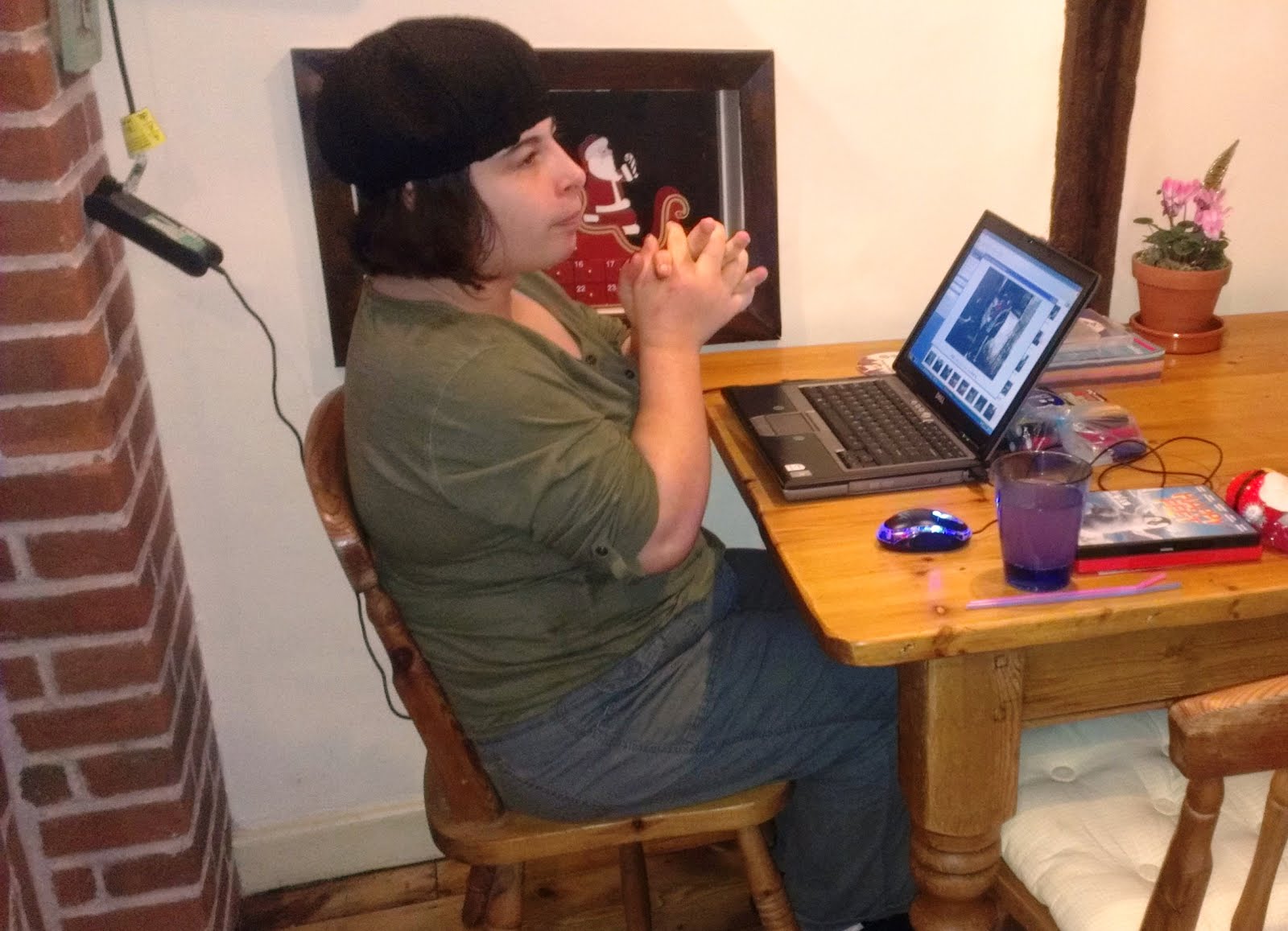
Yesterday, with typical hand-clasp posture, hat on indoors and sleeves rolled up

This question ignited fierce debate when Sally Roberts ran away with her 7-year old son to prevent his radiotherapy cancer treatment for a brain tumour.
http://www.dailymail.co.uk/femail/article-2246877/Sally-Roberts--disappeared-Neon-prevent-having-radiotherapy--talks-ITV-Daybreak.html

However, I believe that Sally Roberts deserves sympathy, not condemnation, especially by ill-informed people online who hadn’t read the whole story. She is obviously frightened & has her son's best interest at heart, even if she may be misguided. Having your child’s life under threat is the most terrifying prospect ever and I can see how it could temporarily unbalance your mind.

I completely understand the need for the courts to step in - parents should have a say in their children's treatment but not necessarily the final decision. I’ve often felt like running away with Chrissy to take charge of her treatment but common sense has prevailed and enabled me to take the longer view. Such an impulsive act could lose me my Deputyship, which means that I’m appointed by the courts to make decisions on Chrissy’s behalf as she lacks capacity to manage her own welfare and affairs. Ultimately, this could leave me powerless to protect her interests in future.

Having said that, I have at times taken a very strong stance over Chrissy’s medical treatment, and it has led to clashes. I know my child’s long, complex medical history better than anyone and always fight her corner if I disagree with her doctors.

I know all too well the feelings of helplessness & desperation when you fear that your child's medical treatment could be doing them more harm than good. Primal instincts take over - I made a rash decision on holiday to stop a treatment that I felt was causing ill-effects – Chrissy's antipsychotic. I held my hands up afterwards & acknowledged that it was a step too far but there had been so many bureaucratic delays over starting the process that I felt desperate. Although her clinicians put her back on the antipsychotic when she returned to the assessment and treatment unit, my actions had the desired effect - although I hadn't done it from a conscious desire to manipulate events. A tapered withdrawal process was started immediately.

Since then, Chrissy has gone from strength to strength. Re-reading my blog post from that holiday, I see that I said Chrissy’s mobility had declined with age – although she’s only 28. I was wrong. Now her meds are sorted out her agility has improved. I’m not sure why, as she's still overweight - maybe she felt dizzy or had vertigo? Her life has been transformed by these long-awaited medication changes. The high levels of self-injury and disrobing that effectively imprisoned her have now reduced so significantly that she is able to go out and about again routinely. As I write this, Chrissy is sitting contentedly next to me turning the pages of her Argos catalogue and pointing out different pictures she likes. Her concentration span and focus have improved no end and she can amuse herself quietly for long periods of time now. Her quirky personality and sense of humour has returned. She laughs, dances and sings again, and notices everything that goes on around her. Last time I blogged about how she was settled enough to cope with a four-hour drive up to Staffordshire to visit her grandma for the first time in around four years.

Chrissy still has her ups and downs, and always will, and her epilepsy is a huge concern, but she is now back to her old self. I can’t emphasise enough how changed she was while on inappropriate medication. She rejected activities that she previously enjoyed, was too unsettled and unfocused to engage in anything for any length of time, and her cognitive abilities and vocabulary had shrunk along with her quality of life. She lost her personality. We thought we had lost her.

What on earth was it like for her? The only way she could express her torment was through violent self-injurious behaviour. There were times that she missed out on weekly visits home because she was so agitated and confused that she didn’t know what was going on, and I couldn’t even get her into my car. This was completely out of character - she looks forward to her home visits all week. Her younger sister even questioned whether her life was worth living at one point because she was suffering such a continual high level of distress. Behaviours included ripping her hair out of her head, leaving her partially bald, breaking her heel by banging it on the floor, gouging and biting her skin until it bled, and sustaining a multitude of bruises, swellings and lacerations all over her body and face through punching, pinching and throwing herself around. She also lashed out at other people, which she only does on occasion when extremely distressed.

Now her hair has grown back and her body is rarely marked from self-injury. Her face has lost its haunted look.

Chrissy can’t express how she feels, and Ian and I often speculate on how she must have felt when she was so distressed on inappropriate medication. There’s nothing worse than watching your child suffer and until you are in a situation like Sally Roberts’s you can’t say what you would or wouldn't do.


I am a SWAN UK (Syndromes without a Name) blogger
MyButton

Monday, 29 October 2012

Assessment and treatment units


A wonderful weekend with Chrissy. Her sister, Alex, and her nana were staying, & we made a Halloween pumpkin. Chrissy called it a witch! Her nana hadn't seen Chrissy for a few weeks and was amazed at the transformation in her now all the meds changes have been done.

But would this have taken place if Chrissy hadn't gone into an assessment and treatment unit? These units are getting terrible press with the latest Panorama Winterbourne View investigation on TV tonight. Politicians and learning disability charities are calling for these 'dumping grounds' to be decommissioned without delay - but don't we need robust alternatives in place first? Anyone who's read my previous posts will know that we've had our issues with Chrissy's ATU and I'm sure there are lots of awful ones like Winterbourne View - but you can't lump them all together. The truth is, it was her only lifeline. Community-based services failed her time and time again. People that present with the most challenging behaviours usually have complex needs that can't always be met in the community. Support workers need better pay & training, and don't get me started on communication. Many of Chrissy's support workers in the past have barely been able to speak English. The best learning disability psychiatrist Chrissy has ever had is the one at the ATU. It pains me to admit it, as we haven't always seen eye to eye on every aspect of Chrissy's treatment, but she's pretty impressive! Other psychiatrists that Chrissy's had in the community have been, at best, out of their depth &, at worst, haven't had her best interests at heart. In a nutshell, a vulnerable adult with challenging behaviour & complex needs can be extremely difficult to manage in the community. If community learning disability teams were up to the job, why has it taken SEVEN YEARS from the start of her deterioration for Chrissy to recover & be herself again?

We learned at last week's care planning meeting that Chrissy is due to be discharged from the ATU in the next couple of months. I'm very nervous about her leaving the unit's health-focused environment. Her epilepsy is still unstable but I'm hoping it's just a blip while the last of her previous meds leave her system - she can react strongly & paradoxically to even the smallest meds change.

To end on a very upbeat note - at the meeting, all Chrissy's therapists expressed their delight at her progress since the last lot of meds changes. They reported marked improvements in her cognitive skills, attention span & willingness to engage with others. She thoroughly enjoys going out shopping and on woodland walks and it's hard to remember the last time she disrobed during an outburst. These recent, very marked, improvements strengthen our case that she needed meds changes, not simply changes in her environment, to retrieve her quality of life. How on earth could the meds changes have been done in the community with what it has to offer currently? Badly run ATUs are the tip of the iceberg. Closing them down without suitable tried & tested alternatives in place is not the answer.


I am a SWAN UK (Syndromes without a Name) blogger
MyButton


Saturday, 13 October 2012

Living at Home again: An Impossible Dream?


West Meon Church

A magical morning with Chrissy. We walked to the village shop for a newspaper and Maltesers. Chrissy behaved perfectly so we stopped for a photo-call in the churchyard. Later as we looked through the pictures on her laptop, Chrissy's face was wreathed in smiles as I showed her how to move the cursors around. She giggled as she made herself disappear then re-appear on the screen – now you see me, now you don’t!


Having it all - enjoying lunch, Cbeebies and today's photos!

My last post was about taking a stand. I can reveal now that it was over Chrissy's Quetiapine - I was so desperate for her to come off it that I stopped it for three days on holiday. Then I admitted what I'd done to the ATU and begged them not to re-introduce it as we had seen improvements in Chrissy's behaviour and mood. It was a rash decision on my part and I've explained my rationale on here before. I had no concerns about the risks as we had seen similar improvements when the ATU had 'forgotten' to give Chrissy half the prescribed dose for a fortnight. For reasons I completely understand her doctors reinstated the drug but immediately began to 'review it downwards.’ (They need to monitor effects.) Chrissy is now on only 50mg once a day. So far so good, although her ward nurse told me that Chrissy had been slightly more agitated at meal-times lately, bending her fingers back and asking repetitive questions about food. However, her nurses have been able to distract her.

As the weekend's gone on, Chrissy's had her moments but she's been relatively easy to pacify and fully engaged in everything we've been doing. As a general reflection of her improved mood over recent weeks, her hair is growing back and looking more lustrous (she isn't pulling it out), and her body is no longer marked by self-injury.

Now Chrissy's behaviour has settled down, I’m feeling more torn than ever about her future. We’re no closer to finding a way to set up the bricks and mortar part of the single service unit option (where Chrissy lives on her own with 24-hour support). You've seen from previous posts how some issues that crop up in residential care haunt me. Now I’m wondering again if there's any way we could make it work for Chrissy to live with us permanently.

Ian doesn't believe that living with us would be the best thing for Chrissy. He fears we could go back to square one if her condition were to deteriorate again. As there's every chance, given her history, that this could happen, anything that's put in place would need to be watertight to minimise the risks of further traumatic moves. It may sound selfish but we're in our fifties and enjoying more freedom now that our children have grown up. It would serve no one if we were to go backwards to a time when Chrissy's outbursts ruled our lives and I felt like a prisoner in my own home with her too unsettled to take out or leave with a care-worker. We would be setting ourselves up to fail if we were propelled back into the fray of pointless crisis meetings and battles to get effective medical treatment and support. So there would need to be strong contingency plans in place, for example, an immediate return to the ATU for further assessment and, if necessary, treatment - and how enforceable would those plans be? I’ve lost all faith in Chrissy's commissioners, with their endless broken promises and buck-passing.

Another question is whether we could devote the time, energy and patience to manage Chrissy's needs as they should be managed and, the biggie that terrifies all parents of disabled children - what will happen when we're gone? As one of the provisions for her future care, shouldn't we ensure that she is settled somewhere that doesn't depend on us being around?

Anyway, it’s all hypothetical right now and I may have blogged myself out of it! Ian’s far more pragmatic than me – I follow my heart but as my book title says sometimes ‘love isn’t enough.’ It’s early days and I'm jumping the gun – a date for discharge from the ATU has yet to be agreed. Chrissy's epilepsy is still not as controlled as her doctors would like it to be and if another anti-epileptic drug is trialled she will need to stay in the ATU for further monitoring as she's had such nasty reactions to the last two.

At the next care planning meeting on 22 October I propose that we ask commissioners to suggest a support package template if having Chrissy back home is a route that Ian and I could agree to explore.....

Since I published this post I was given more food for thought when another mum of a child with learning disabilities wrote a piece for the Daily Mail that included her take on the residential care dilemma. She questions whether it would be cruel to leave her daughter unprepared and unprotected when her parents die: http://www.dailymail.co.uk/femail/article-2219305/The-daughter-taught-meaning--love-Lady-Astor-pays-moving-tribute-autistic-little-girl.html


I am a SWAN UK (Syndromes without a Name) blogger
MyButton


Saturday, 29 September 2012

The Holiday where I Took a Stand: Valuing Lives of Adults with Learning Disabilities


Chemically coshed?

We set off for Center Parcs, Longleat, with trepidation and a back-up plan. Our last holiday with Chrissy had taken place over four years ago, and it hadn't gone well. At least Longleat is only an hour or so from our home and the ATU. If it all went belly-up we had the option of taking Chrissy back....

On the first day Chrissy’s behaviour can only be described as ‘monstrous!’ She roared and barked endless demands that we could never satisfy. Her appetite was insatiable too. We ate at Café Rouge as soon as we arrived but the minute Chrissy had cleared her plate, she began obsessing about food again. These behaviours continued at the villa and escalated to outbursts with the usual thrashing around on the floor. Thankfully, the episodes were short-lived and in our own space we could let her get on with it.

‘I’ll never do this again,’ Ian muttered darkly. Eventually, Chrissy sat down with us, but we were still jumpy and tense with her and each other, wondering if we'd made a big mistake to bring her there. Then I heard a soft giggle beside me. When I turned round, Chrissy was smiling and pointing at the objects of her amusement – my feet on the coffee table wiggling in time to music on TV. My heart melted. People with autism rarely gesture or point at objects to communicate. Chrissy has started doing this very occasionally, and they are special moments.

The next morning she played up while taking her meds and I had to try again later with her antipsychotic, Quetiapine, and her fish oil supplement. Within around half an hour she looked so drowsy I thought she was going to have a seizure. Here, with more time on my hands, I was able to observe Chrissy more closely & objectively than I do at home. In previous posts I've described my concerns about the clinical need for her to be on Quetiapine or indeed any antipsychotic. I bring it up at every care planning meeting but it never seems to be the right time to trial Chrissy off it - her doctors want to stabilise her epilepsy first (yet antipsychotics lower seizure threshold!) or they want to wait for a more settled period or wait for the next specialist appointment etc. The ATU halved her dose in error several months ago and noted improvements in her behaviour - so why is she still on it nearly three years after I first expressed concerns?

Once we got to Longleat Chrissy kept whingeing, nagging about food, and sitting down and refusing to move on. Just after we entered the African Village, she body-swerved back to a sweet shop we’d passed & surfed the displays for Maltesers.

They’d run out.

Cue Chrissy to throw herself on the floor, where she stayed for around 15 minutes. She lay there quietly, only shrieking when we tried to talk to her or get her back up on her feet. We stood there like lemons until, finally, she got up and selected a pack of fun-sized Kit-Kats that shared the closest resemblance to Maltesers. With the sweets secured in her coat pocket, we were able to continue on our way.

We got stuck again by the meerkats – the first animals we came to. Unlike most people, Chrissy wasn’t impressed by their antics even when six of the endearing creatures stood upright in unison. We accepted that we would be operating on ‘Chrissy-time’ that day. Next, she made a bee-line for Postman Pat Village then plonked herself down on the ground again and threw my sunglasses, which she’d been wearing, to the ground. As so often happens, just as you want to wring her neck Chrissy's mood about-turns. She agreed to a photo opportunity with Postman Pat and was charmed by the inanimate model. It engaged her attention more than any of the animals we’d seen.


On the way to the game park, we stopped at the toilets. Chrissy started shrieking and shouting on the loo and sent the sanitary disposal unit crashing to the floor. We emerged to curious stares then she flung herself to the ground again as a group of school kids filed by, eyeing her warily. Chrissy didn’t react to their presence. As usual, she got up when she was ready and we set off on the drive-through safari. Clutching her empty paper Coca-Cola cup and bag of Kit-Kats like talismans she seemed content enough but showed no interest in the animals.


Wednesday was a better day - we got Chrissy into the pool & spent an hour or so there - but the biggest blip of the holiday occurred that evening at the Pancake House. They had a children’s entertainer on and refused entry to anyone that hadn’t pre-booked. I tried my best to persuade them, but to no avail. Needless to say Chrissy kicked off right outside in full view of the diners. The manager rushed out with a complimentary all-singing-all-dancing pancake, the sight of which sent Chrissy into orbit. She threw herself on the ground screaming, thrashing around and banging her head. To further fan the flames, a man who’d been sitting outside drinking tried to step into her world. He lay down on the ground beside Chrissy and started talking to her. ‘I work with kids like this,’ he slurred to us. ‘They're so lovely.....’

Chrissy smacked him in the face!

I explained that we have to pretend Chrissy is invisible when she goes into these states as any eye contact or attempts to communicate makes things worse. She has to be left to come out of it on her own. The man’s daughter came outside with his grandchild. Gradually, Chrissy became aware that there was a baby nearby and sat up. It was a rapid mood switch even for Chrissy. ‘Is it a baby?’ she twinkled. ‘Can I stroke her?’ We watched nervously as Chrissy softly caressed the baby’s back and chatted away, asking questions like: ‘What’s your name baby?’ It was a stark contrast to the violence of her outburst, and I was pleased for Chrissy that this family had seen her at her best. It was interesting that Chrissy asked the baby: 'Have you stopped crying now? Were you cross?' (signing the word for cross) Ian and I both think that Chrissy was talking about herself in a third-person kind of way.

Chrissy then plonked herself down between us and tucked into her pancake, chatting and giggling with the man, who was definitely the worse for wear but harmless. He kept Chrissy entertained, pretending to nick her food and joking about taking her on a date. After we left Chrissy couldn't stop talking about her new 'friend.' The experience had been quite surreal - but what a happy ending!

Thursday was better still. We managed to get Chrissy on a trike. She let us push her around but didn’t pedal or steer it herself. She used to race around on her own trike but her mobility has decreased with age – she struggles to climb on and off things, and has lost agility, skills and confidence. This deterioration also coincides with her weight increase since the introduction of antipsychotic drugs.....I hasten to add here that the sweets she gets are carefully rationed & the cokes are diet &, where possible, caffeine free, diluted with water. It's about what the packaging represents. Although Chrissy loves to eat she can happily hold on to her favourite branded food items for days.


Later on we transferred our holiday photos to Chrissy’s laptop. She sat entranced flicking through them. Her mood got better and better. We went for an early evening stroll – she walked a total of around two miles that day. Later, she watched the Bear and Father Christmas instead of sticking rigidly to her Snowman DVD. As she watched Father Christmas, she smiled over at us while excitedly tapping his picture on her DVD cover to show they matched. It was a lovely last evening.


The next day Chrissy woke up to an empty villa – everything had been packed away. It struck me that it was like the end of the Snowman DVD where all that remained of the night's magic was his hat & scarf. Chrissy reacted well considering - no nagging for food, and quite compliant given that we had to rush her out of the villa by 10am - but we could tell she was bewildered and disorientated. I felt a huge sense of desolation for her that grew as we drove back to the ATU. The villa had become home. She'd had her favourite things around her, & now they were all gone until her next visit home.

At the ATU she asked for her laptop again. Unfortunately we’ve never been able to get them to agree to keep it there – nowhere safe to store it we’re told. It seems harsh to deny her one of the few things she loves to play with but she has a toy laptop there that’s become another favourite activity. Hoping to distract her, I asked a nurse where it was. She looked at me blankly. I kept on until someone went to search for it and eventually brought it out to us without batteries. How long had it been stored away out of Chrissy's sight because it couldn't be used? Why hadn’t anyone thought to tell us or use her pocket money to buy more batteries? She gets attached to treasured objects like this & has so few of them there. I find this sort of thing beyond upsetting. It symbolises something that I can't bear to think about, let alone put into words for a blog.

While we were unpacking later at home, I couldn't stem a sudden flood of tears. It felt like grief....

Our holiday had highlighted how life is passing Chrissy by while we wait interminably for actions to be taken that will move things forward. A care planning meeting that I'd hoped would lead to progress with some of these actions was postponed by SEVEN weeks because key professionals were on holiday, only worked on certain days or were attending training days. The upshot of it all is that I decided to take the lead on something that has been dragging on for far too long. It could get me into hot water but it's worth it if the end justifies the means....


I am a SWAN UK (Syndromes without a Name) blogger
MyButton

Monday, 3 September 2012

Battle Weary but Making Progress


Chrissy age 9. The start of more turbulent times. Note self-inflicted scratches on face & around eyes

As we continue to marvel over Chrissy's emergence from medication-induced cognitive impairment and behavioural changes, we are looking at her future care options. Although we haven't got a discharge date yet, we're nearing the end of Chrissy's treatment but can't make firm plans until the funding dispute is resolved. A personal support package needs to be in place before Chrissy can take up any housing options that may be offered but despite the efforts of a solicitor, an ombudsman and ourselves, progress is still painfully slow.

A mum that faces similar challenges to ours said she has always tried to take a reasonable approach but feels her constant efforts to improve her disabled child’s life are an uphill battle without any action. Another parent said she was in despair as she doesn’t see any significant changes coming to ensure good, long-term care for her child. ‘I’m sick and tired of all the stress and worry, and the coping,' she says. 'I want to be heard. I’ve had enough.’

Battles can start early on when you have a child with a learning disability, particularly if the cause is unknown or the child has complex needs. My book ‘Bringing Up a Challenging Child at Home’ http://www.jkp.com/catalogue/book/9781853028748 describes my attempts to get someone to take my concerns seriously. No one ever sat me down, and took time to listen and explain anything. I was always asking ‘what’s wrong with my child?’ I felt like I was being fobbed off and became increasingly frustrated.

Eventually, it became chillingly obvious that something was wrong. Chrissy was diagnosed with epilepsy when she was 10 months old and, later, with developmental delay. She received physiotherapy, occupational therapy and speech therapy but these services were snatched away when we moved to a different area. It was our first experience of the postcode lottery but not our last - a decade later Chrissy's respite care allocation was halved when we moved to another county. I didn't know how to go about challenging these decisions but I've since learned that it's only those who shout loudest that get the help their child needs.

During Chrissy’s early school years things went relatively smoothly. She had sufficient support in lessons to help her to achieve her potential and was under the care of Great Ormond Street Hospital, who took quite an interest in her. It was only as she grew bigger and more difficult to manage that the battles began in earnest. Health professionals and Social Services seemed to write Chrissy off & wouldn't offer sufficient support. I guess no one really knew what to do and they feared that they would carry the can if something went wrong.

When Chrissy was nine doctors began prescribing anti-psychotics and sedatives to try to subdue a particularly intense outburst cycle but the episodes escalated and became more violent and prolonged than ever. Over the next four years there was one crisis after another as her SLD school struggled to cope and so did we. We were using behavioural intervention strategies but they only helped with day-to-day challenging behaviours, not with these more severe episodes.

Finally when Chrissy was 14 Ian and I snapped after she'd had several days of frenzied self-injurious outbursts while on the anti-psychotic, Haloperidol. Somehow we got her down to our local children’s ward. 'This is our daughter, Chrissy,' we told an appalled nurse,'and we're not taking her home until someone helps her.’ We had a heated discussion with hospital staff when they realised we were sticking to our guns but once they got a handle on the situation they agreed to help. I’ve described Chrissy’s transformation in just 14 days after those meds changes in previous posts. For the next few years things ran relatively smoothly again - but when her meds were withdrawn after the platelet drop, I was propelled back into the fray.

The dreaded anti-psychotics were re-introduced, and Chrissy's behaviour & quality of life deteriorated again. Her doctors wouldn't accept anti-psychotics were making things worse AGAIN, and argued instead that it was all down to her being in the 'wrong' environment for someone with autism. There were endless disputes over the right course of action to take and Chrissy was stuck in the middle. In 2008 after another awful cycle of extreme outbursts, she was given 28 days' notice of eviction from her residential care home. I fought a legal battle to give us extra time for a transition to another care home, then when that placement broke down amidst the all-too familiar backdrop of medical professionals doing nothing and citing the 'not-fit-for-autism' environment, I had to take legal action again on two separate occasions to get Chrissy into hospital for assessment and treatment.

While parents of neurotypical children face occasional set-tos our battles are never-ending and instead of stopping when they become adults, they get worse. There's always another 'concern' to address along with major ongoing issues rumbling in the background, and we go through periods of reeling from one crisis to another.

In my previous post Groundhog Day http://jgregorysharingsstories.blogspot.co.uk/2011/10/special-saturday-post-groundhog-day.html I describe how I feel like I'm continually revisiting the same issues. For example, last year's admissions and apologies from the NHS trust about making a ‘dog’s dinner’ of Chrissy’s assessments for healthcare funding, and their promises to rectify the situation with properly conducted assessments and thorough investigations have come to nothing. I"ve lost count of how many times my hopes have been raised like this. Another parent described it as like kicking a football around a triangle. You are in the centre of the triangle created by professional services and your issue just gets kicked around from corner to corner as the professionals that you go to for support pass the buck and blame each other. After going down all these frustrating routes of trying to get someone to take responsibility and action you are left back where you started to kick the football from.

Meanwhile, Chrissy's epilepsy remains unstable, and other health worries keep cropping up that leave me feeling acutely aware of the fragile balance between symptom control and quality of life. We intend to make the most of the good times while they last. That's why we're taking Chrissy on holiday to Center Parcs at the end of the month. Wish us luck!


I am a SWAN UK (Syndromes without a Name) blogger
MyButton