Showing posts with label self-injurious behaviour. Show all posts

Wednesday, 31 July 2013

Being Chrissy's mum


A beautiful day...

But behind the scenes, I'm struggling with feelings of sadness and loss. We were so thrilled to get Chrissy back at the end of last year - to see the return of her zest for life and her enthusiasm for doing jigsaw puzzles, to take her on holiday, out with family, and shopping for new shoes, her grandma's reaction when we took her up north to visit her for the first time in years.....

Now, Chrissy's slipped away from us again and I'm gripped by the green-eyed monster whenever I see or hear about other adults with learning disabilities going out with their parents. It's routine for many such families but for us, outings and holidays with Chrissy are rare and precious events, often fraught with drama, to be celebrated when they go well. Chrissy just can't manage them at the moment and I realise that we're running out of treatment options. Her epilepsy no longer responds to monotherapy and nearly every secondary antiepileptic drug out there has been tried. She is so acutely sensitive to the neurological mayhem these drugs can cause that they stop her living her life. She isn't complying with bathing, teeth-cleaning etc and is still refusing food. Mood swings continue to be marked - one minute smiling and calm, the next screaming and shouting. She is disrobing on the unit but we haven't seen this at home - just shoes and socks off. She has bruises all over her body again from self-injurious behaviour - the only way she can express her distress. Two weeks ago I'd noticed bruising on her neck & had to raise my concerns at a higher level. I've never seen bruising there before & we're now awaiting the outcome of further investigations into how & when it happened. The explanation I got was too vague for comfort.

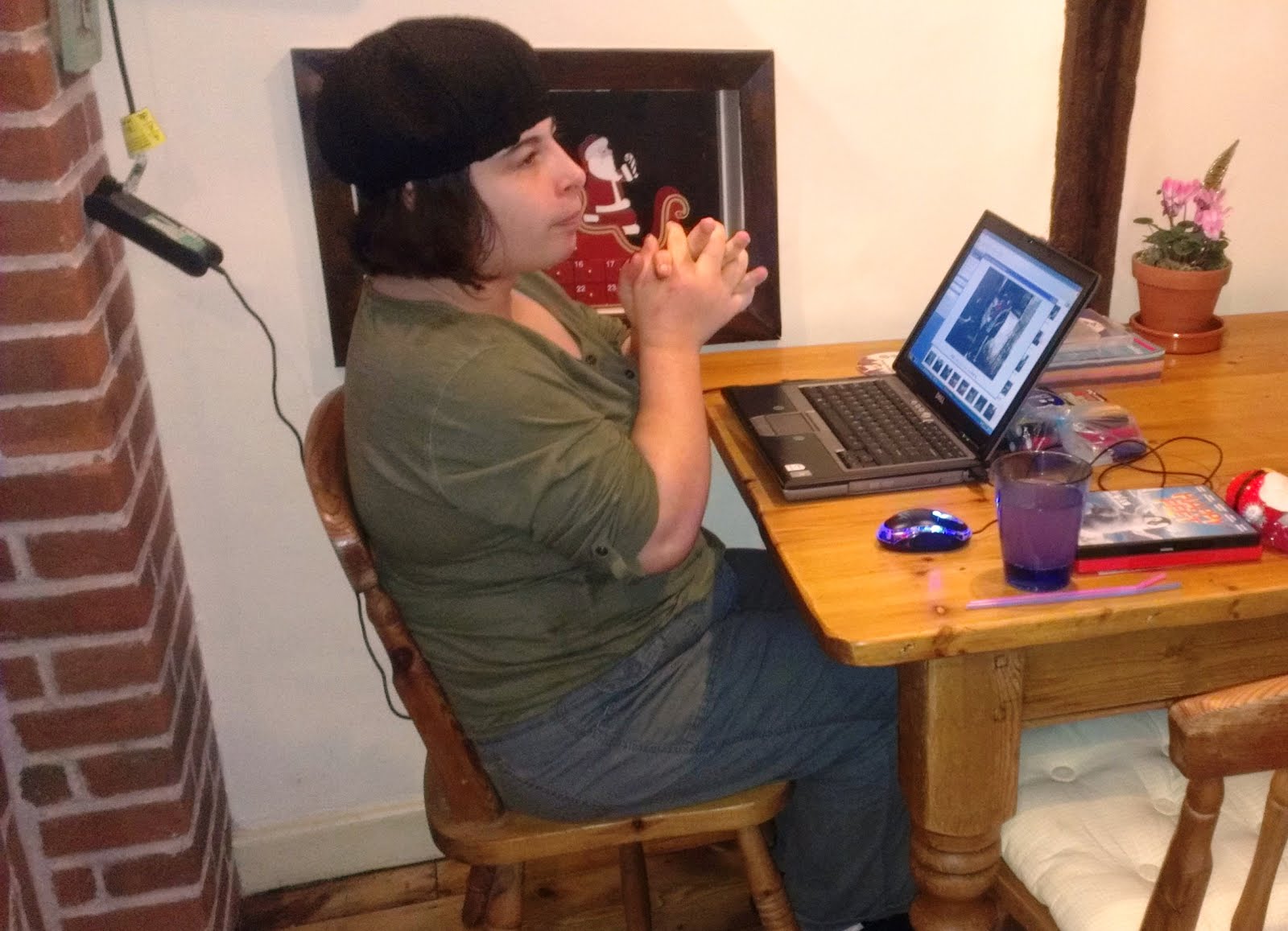
The weekend before last when that picture was taken Chrissy was so excited to see her brother, Jamie. His girlfriend, Penny, looks a bit like her sister, Alex. Chrissy thought she WAS Alex - & not just fleetingly. When Alex herself turned up later, Jamie and Penny had left. Chrissy transferred the name seamlessly to the real Alex. I'm uneasy about her confusion. She's always known who close family are even if she forgets other people's names. Another point to mention to her neurologist on Thursday when her antiepileptics are reviewed. The deterioration in Chrissy's health & mental state is something that he will be trying to resolve. The unit has no epilepsy specialists - the neurologist is based at a local NHS hospital. There's nothing more the unit can do for her now and, given the current situation, it's detrimental for her to stay there. So why is she still there?

Some of the housing barriers we've faced have shifted but new ones have popped up. We made a successful bid on a council house in the village but, although we were never given the chance to view it inside, we went with the professionals' views that it was unsuitable due to a number of safety issues in relation to where it was situated and the internal layout. The more housing options we consider the clearer we are about non-negotiables but it's hard to keep having your hopes raised only to have them dashed again. There are very few houses that become available in this area but Chrissy still has priority banding so I will keep checking the social housing website. The other option that's starting to look promising is shared ownership. A specialist housing association has finally come on board and we're having discussions about a house for sale nearby that meets their budgetary requirements. They are concerned about the noise impact on neighbours from any house with a party wall, even with sound-proofing, but a detached property is out of the question due to cost. The noise/disruption to neighbours issue must be a common theme with most people being moved out of assessment and treatment units into supported living and the Winterbourne View Joint Improvement Programme needs to address this.

The tendering process for providing the care package is also moving painfully slowly. I know we'll get there eventually but Chrissy has now spent 3 1/2 years in a locked ward. "What must it be like for her?" I asked Ian recently in a tearful moment. "We'll never know," he said. "You try to put yourself in her shoes but you can't see it like she does and there's no point even speculating."

He's right of course and I need to get a grip - but what mum wouldn't feel like I do? My heart is always at war with my head. I long to kidnap Chrissy and bring her home but I know the situation would be unmanageable, and certainly not in her best interests.

Last week Alex asked: "Do you ever resent Chrissy?"

"No," I answered as honestly as I could. "None of this is her fault. It's the situation I resent."

Reflecting on this question today I can recall times when I've felt fiercely resentful, but only in passing, the same way that I resent Ian when he keeps does something infuriating no matter how many times I ask him not to - like dumping his work briefcase on the kitchen floor!

Alex has just started work as a tutor at a unique school for children with autism, using ABA (Applied Behaviour Analysis) http://www.ambitiousaboutautism.org.uk/page/treehouse_school/teachingandlearning/aba.cfm She's very excited about this new opportunity. She has always felt helpless in the face of Chrissy's suffering, even as a small child. Now she feels able to channel her conflicting emotions, and to use her valuable family experiences and training as a psychologist and teacher to improve the lives of other young people who struggle with autism and learning disabilities. Perhaps we can, in consultation with Chrissy's support team, try some ABA strategies once she moves into supported living.

Naively perhaps, I'd once hoped that similar autism-specific approaches would be used in assessment & treatment units & residential homes that claim to specialise in autism. Maybe one day.....


I support Unique http://www.rarechromo.co.uk/html/home.asp & I'm a SWAN (syndromes without a name) blogger
SWAN UK

Sunday, 12 May 2013

Legal Challenges and our Hopes for a Better Future

It's been a tough week and at times I've felt overwhelmed. We've been dealing with solicitors over difficulties with the plans to move Chrissy on, and have seen a return of some of her old challenging behaviours. Issues with the quality of personal care she'd been receiving had resurfaced but, thankfully, they've been resolved again.

We've had crisis times like this throughout Chrissy's life. I'm painfully aware that some quality of personal care problems could be avoided if Chrissy lived with us full-time but, as we experienced this weekend, it could never work for a number of reasons. I discuss this dilemma in a previous blog http://jgregorysharingsstories.blogspot.co.uk/2012/10/living-at-home-again-impossible-dream.html Some adults with a learning disability can thrive in the home setting. Chrissy isn't one of them and this is the case with many adults with a learning disability that display severe challenging behaviours. Even when Chrissy is at her most settled, she is full-on and can't be left unsupervised. Her intellectual functioning is at a similar level to a two-year old's - imagine the difficulties that a stroppy adult-sized toddler would present - and then some! When Chrissy's unsettled, as she was this weekend, her moods are balanced on a knife edge and it's like living in a war zone. As part of our legal challenge, I've been reading through old care records and they're a brutal reminder of what day-to-day life can be like with Chrissy. These behaviours have proved impossible to manage even in residential settings geared up for such challenges.

We hope that the reversion to old behaviours is temporary. As Chrissy's Zonisamide has been gradually upped, she's had spells of wetting herself at night and sleeping excessively - but then those side-effects have worn off in time for the next dose increase. Now it's been increased to its optimum therapeutic level, which seems to have tipped her over the edge. On the unit last week she'd had nosebleeds and kept wanting to go back to bed during the day. When she came home on Friday, she seemed fine at first then her mood kept switching from tears to manic laughter to shouting and demanding things. She took to the floor several times, biting her toes and pulling her hair. She demanded the same things over and over, like a stuck record, but whatever we gave her wasn't enough. She was generally more irritable and destructive, and broke her laptop mouse when she threw her laptop across the room. Ian's bloody brilliant when she gets like this; he's so patient with her, much more so than me. I find these rage episodes and prolonged periods of distress completely draining and they throw up painful feelings - resentment, guilt, pity, anger, grief, fear, helplessness, inadequacy....

Chrissy complained several times that she felt sick and, because she kept getting 'stuck' in one place and couldn't move on, yesterday, she couldn't even settle down to eat. Everything from persuading her to take her medication to getting her into the bath took far longer than usual. Then, when we finally managed to get her into the car and back to the unit at around 5.30pm, she wouldn't move out of the car. These aren't quite the same as her frozen states because she isn't content to sit quietly in her own space. It was upsetting to see her so distressed again but she is still alert and has all her wits about her. In fact, at one point, so determined was she to stay put, that she locked herself in the car. We had keys of course but there's no moving Chrissy when she doesn't want to be moved! We got stuck at the unit for ages, and had to laugh as we swapped places with Chrissy. We thought that if we hid out of sight behind the entrance gates she'd get bored and call us to be let out. Not a bit of it! Eventually her care-worker had a brainwave - to move the car slightly closer just to jolt Chrissy out of her fixed position. It worked but she took to the ground outside and still refused to move. At least we got our car back!

So on to the legal challenge - I've posted previously about the Ordinary Residence and Continuing Healthcare funding dispute, which kicked off after we relocated to a new county when Chrissy moved into Adult Services at 19. The timing of our move and the fact that Chrissy's condition worsened afterwards turned her into a political hot potato. The upshot is that we've had to engage solicitors yet again because the funding dispute is still adversely impacting on her life. As my husband, Ian, puts it: 'If we hadn't kept driving things on, Chrissy would have been condemned to a wretched life.' As the funding dispute started in 2008, it's hard to understand why an independent higher authority haven't been brought in to resolve it by now. It looks like this nearly happened in 2011 but the commissioners intervened by agreeing to a process called 'local resolution.'

A local resolution meeting was held in November 2011 and they promised to put things right. They offered to carry out a retrospective continuing healthcare assessment, which would be a major step towards solving the funding dispute and determining who was responsible for funding Chrissy's care package. They promised to complete it by February 2012. We're still waiting. Now they say Chrissy can stay in hospital until they've completed the assessment and funding responsibility is determined - yet they still haven't specified a definite date......

We are also concerned that if they claim that someone else has funding responsibility, the other official body will appeal, which will then lead to further delays. So we've been forced to bring matters to a head and have engaged solicitors. Last week the commissioners replied to their letter before action. I've spent the past few days correcting facts and omissions in their reply, and adding further evidence to strengthen our case, ready for the solicitors to prepare for the next step. Is what they're doing actually unlawful or just poor practice?

Chrissy's case is further strengthened by a wonderful letter from Mencap. Quotes include: 'It has been extremely difficult for Mencap to understand why the situation has remained stuck for so long.....'The amount of correspondence that Chrissy’s family have had to engage in to try and understand the barriers, and to try to move things forward for their daughter is difficult to believe.....''There has still been no proper assessment of Chrissy’s needs on which to base the planning......' 'The Government is very clear that people with a learning disability should be supported to live in their own communities. There is no reason why Chrissy should not be living in her own home near her family. It is crucial that the accommodation meets her needs and that she gets support from staff who are able to meet her complex health and behaviour needs. It is also crucial that she can get the right input from medical professionals, when needed.....' 'Chrissy should have the same opportunity to enjoy life as other young women her age, with the right support. She should not be living in a unit....' 'I am sure you will agree that it is unacceptable for the situation to continue as it is. I think we can all imagine how damaging and stressful it is for Chrissy and her family.'

Let's hope that we're nearing the end of this damaging chapter in our lives and that the outcome will enable Chrissy to live her life in the way that she'd want to. http://jgregorysharingsstories.blogspot.co.uk/2011/08/how-id-like-my-life-to-be-by-chrissy.html


I support Unique http://www.rarechromo.co.uk/html/home.asp & I'm a SWAN (syndromes without a name) blogger
SWAN UK

Sunday, 16 December 2012

Should Parents Intervene in their Child's Medical Treatment?


Yesterday, with typical hand-clasp posture, hat on indoors and sleeves rolled up

This question ignited fierce debate when Sally Roberts ran away with her 7-year old son to prevent his radiotherapy cancer treatment for a brain tumour.
http://www.dailymail.co.uk/femail/article-2246877/Sally-Roberts--disappeared-Neon-prevent-having-radiotherapy--talks-ITV-Daybreak.html

However, I believe that Sally Roberts deserves sympathy, not condemnation, especially by ill-informed people online who hadn’t read the whole story. She is obviously frightened & has her son's best interest at heart, even if she may be misguided. Having your child’s life under threat is the most terrifying prospect ever and I can see how it could temporarily unbalance your mind.

I completely understand the need for the courts to step in - parents should have a say in their children's treatment but not necessarily the final decision. I’ve often felt like running away with Chrissy to take charge of her treatment but common sense has prevailed and enabled me to take the longer view. Such an impulsive act could lose me my Deputyship, which means that I’m appointed by the courts to make decisions on Chrissy’s behalf as she lacks capacity to manage her own welfare and affairs. Ultimately, this could leave me powerless to protect her interests in future.

Having said that, I have at times taken a very strong stance over Chrissy’s medical treatment, and it has led to clashes. I know my child’s long, complex medical history better than anyone and always fight her corner if I disagree with her doctors.

I know all too well the feelings of helplessness & desperation when you fear that your child's medical treatment could be doing them more harm than good. Primal instincts take over - I made a rash decision on holiday to stop a treatment that I felt was causing ill-effects – Chrissy's antipsychotic. I held my hands up afterwards & acknowledged that it was a step too far but there had been so many bureaucratic delays over starting the process that I felt desperate. Although her clinicians put her back on the antipsychotic when she returned to the assessment and treatment unit, my actions had the desired effect - although I hadn't done it from a conscious desire to manipulate events. A tapered withdrawal process was started immediately.

Since then, Chrissy has gone from strength to strength. Re-reading my blog post from that holiday, I see that I said Chrissy’s mobility had declined with age – although she’s only 28. I was wrong. Now her meds are sorted out her agility has improved. I’m not sure why, as she's still overweight - maybe she felt dizzy or had vertigo? Her life has been transformed by these long-awaited medication changes. The high levels of self-injury and disrobing that effectively imprisoned her have now reduced so significantly that she is able to go out and about again routinely. As I write this, Chrissy is sitting contentedly next to me turning the pages of her Argos catalogue and pointing out different pictures she likes. Her concentration span and focus have improved no end and she can amuse herself quietly for long periods of time now. Her quirky personality and sense of humour has returned. She laughs, dances and sings again, and notices everything that goes on around her. Last time I blogged about how she was settled enough to cope with a four-hour drive up to Staffordshire to visit her grandma for the first time in around four years.

Chrissy still has her ups and downs, and always will, and her epilepsy is a huge concern, but she is now back to her old self. I can’t emphasise enough how changed she was while on inappropriate medication. She rejected activities that she previously enjoyed, was too unsettled and unfocused to engage in anything for any length of time, and her cognitive abilities and vocabulary had shrunk along with her quality of life. She lost her personality. We thought we had lost her.

What on earth was it like for her? The only way she could express her torment was through violent self-injurious behaviour. There were times that she missed out on weekly visits home because she was so agitated and confused that she didn’t know what was going on, and I couldn’t even get her into my car. This was completely out of character - she looks forward to her home visits all week. Her younger sister even questioned whether her life was worth living at one point because she was suffering such a continual high level of distress. Behaviours included ripping her hair out of her head, leaving her partially bald, breaking her heel by banging it on the floor, gouging and biting her skin until it bled, and sustaining a multitude of bruises, swellings and lacerations all over her body and face through punching, pinching and throwing herself around. She also lashed out at other people, which she only does on occasion when extremely distressed.

Now her hair has grown back and her body is rarely marked from self-injury. Her face has lost its haunted look.

Chrissy can’t express how she feels, and Ian and I often speculate on how she must have felt when she was so distressed on inappropriate medication. There’s nothing worse than watching your child suffer and until you are in a situation like Sally Roberts’s you can’t say what you would or wouldn't do.


I am a SWAN UK (Syndromes without a Name) blogger
MyButton

Wednesday, 25 July 2012


Enjoying life: Chrissy in 2003 with her sister Alex

After years of suffering, your child is given a 'wonder drug' that transforms her life - then it is snatched away because it could kill her. Over the next seven years different alternatives are tried but nothing else helps. What do you do? Do you try it again, under close medical supervision and make the most of the quality time it gives your child - or do you dismiss it as too risky?

This is what happened to Chrissy with Naltrexone.

In previous posts I've spoken in more detail about how low-dose Naltrexone stopped Chrissy's self-injurious outbursts, and why it was discontinued. The following information from Autism Research Institute explains the physiology. It's important to not that when self-injury is associated with a biochemical abnormality, there may be little or no relationship between the person's physical/social environment and self-injury. Thus, the behaviour may occur in various settings and around different people but may occur less frequently during situations in which the person's behaviour is incompatible with self-injury, such as eating, playing, and working on a task.

Here, I'm more interested in exploring our dilemma over Naltrexone, which has divided opinion between some of Chrissy's medical specialists and I. Those that have done their research and/or seen its effects consider it to be a very safe drug but, some of them are wary prescribing it off-label. Naltrexone isn't a drug that is closely linked to thrombocytopenia but Chrissy has a history of rare and paradoxical side-effects from medication.

She was on three different drugs when thrombocytopenia was diagnosed, one of which was Epilim, an antiepileptic drug that she's been on since childhood that has proved the most effective at controlling her seizures with minimal side-effects. Naltrexone and Prozac were introduced together during drug trials when Chrissy was 14 in an attempt to quell unexplained self-injurious outbursts that were escalating in frequency and severity. The combination of the two was unusual and I don't know where the suggestion originated. Seven years of behavioural stability followed during which Chrissy was able to go on holiday abroad and enjoy activities in the community. Then when she was 21 Naltrexone and Prozac were withdrawn together because by the time her thrombocytopenia was detected it was a medical emergency. Her platelets reverted to normal levels within 48 hours so her doctors concluded that the thrombocytopenia was caused by a combination of Prozac and Naltrexone. I have

Epilim was continued but the dose was halved about a year later when Chrissy's platelets dropped slightly again. This shows that at higher doses Epilim alone affected platelet levels.

Three years later Prozac was re-introduced, albeit at half the previous dose. There was an improvement - not life-changing but enough to work out that if Chrissy wasn't taking it things would be even worse. There have been no further concerns over her blood count, which is checked routinely.

So Chrissy is now on two of the three drugs, albeit at lower doses, that she was taking during her thrombocytopenia episode. Do we assume then that Naltrexone alone was the culprit or was it a cumulative effect of all three drugs?

The quality of life question came up last week. Framing it was the fact that Chrissy had enjoyed seven good years on Naltrexone. Now her blood counts are fine do we risk re-introducing it under close medical supervision to see if she can enjoy another long period of relative stability? Of course there are finer points to consider, ie, could Prozac be swapped with an alternative anti-depressant; is there an alternative opiate-blocking treatment to Naltrexone? Both these options would mean more drug trials......


I am a SWAN UK (Syndromes without a Name) blogger
MyButton


Sunday, 20 May 2012

Eating Issues: A Special Saturday Post

Here, Chrissy is clutching her lunch-box in a carrier bag with its handles tied in a bow. Taking a packed lunch and indulging her food-related rituals enabled us to enjoy a trip to Exbury Gardens yesterday with her two nanas.
Chrissy has always been obsessive about food - from failing to thrive as a baby to over-eating as an adult. As a newborn Chrissy's suck was weak and she vomited frequently. Even as an infant, she suffered prolonged screaming bouts in which she would fling herself backwards as if in the grip of a painful spasm. I suspect she suffered from reflux as this is a characteristic of her chromosome disorder.

At her six week check I was advised to put her on solids as she wasn't gaining sufficient weight. The dramas at mealtimes began in earnest then. Chrissy choked, gagged and vomited her way through the weaning period, especially the stage 2 baby foods with lumps, as I agonised over where I was going wrong. I pureed her food for several years as she seemed unable to chew. The vomiting eventually eased but Chrissy's appetite remained poor. She limited her diet to a few select smooth foods, such as Petit Filous - the little fruit cream cheese pots, and Weatabix, mashed up with lots of milk.

Changes came gradually as Chrissy grew bigger and wanted the same foods as her siblings and peers - but she was still very picky and ate painfully slowly. When she was around 10 and anti-psychotics were introduced, her appetite increased and her diet became more varied. It got to the point where she'd eat anything and never seemed to feel full. Her weight decreased again when she went on Prozac and Naltrexone at 14, and during her six-month stint on a gluten and casein free diet. Her weight dropped to five stone when she was 22 and had the platelet problem. She would only eat cheese flan initially, then ate so little we wondered how she survived. After her hospitalisation, anti-psychotics were re-introduced on a daily basis, and she became increasingly obsessive about food. In fact, before her microdeletion was found she was even tested for Prader-Willi Syndrome, a genetic disorder characterised by over-eating and food obsession.

These days, Chrissy is overweight and her life revolves around food. She repeats the same food-related questions every couple of minutes 'what's for dinner?' 'What am I having?' 'Is it peanut butter?' etc. If we ignore her or don't answer in the right way she gets increasingly agitated and if she has to wait for food her obsessions will escalate into a self-injurious outburst. Due to these outbursts, particularly her stripping behaviours, we're very nervous about taking her out of the house. The trip to Exbury was a ridiculously ambitious plan but I knew that, for different reasons, it was a special place for Chrissy's nanas, and at this time of year it's at its most spectacular. We got there late - about 3.30 - because we couldn't rouse Chrissy from one of her sleepathons - but the long deep sleep had left her full of life, and she was thrilled to be there. The only heart-stopping moments came on the moving steam train when Chrissy announced several times with increasing urgency: 'I want to get off! Thankfully, Ian's iron grip, and our frantic distraction techniques and shameless bribery ('shall we open your picnic? What would you like next - cake or chocolate mousse?') worked a treat. She finished her picnic later in the most idyllic setting imaginable surrounded by a riot of colourful blooms, including the glorious rhododendrons Exbury Gardens are famed for. I'm so glad we decided to risk it. What a magical afternoon!


I am a SWAN UK (Syndromes without a Name) blogger
MyButton

Friday, 4 May 2012

Living without a Diagnosis


I wrote this piece for Women's Realm when Chrissy was 12....

Chrissy is mad about music. Last summer the whole family went to our local fete in Hemel Hempstead where a brass band was playing. Before I knew it, Chrissy had barged past the conductor and was conducting the band herself! Fortunately the musicians found it highly amusing.

This eccentric, endearing behaviour is typical of Chrissy, who finds it impossible not to start dancing if we go into a shop with background muusic. She has moderate to severe learning disabilities but I don't know the exact nature of her problems. I've never been told what to expect from her in the future, and, hardest of all for me to come to terms with is the fact that she's never had a diagnosis.

I've battled through some tough years and I know there'll be more obstacles ahead, but I've learned to enjoy Chrissy's cheerful, funny manner and to live with her violent tantrums and obsessive behaviour.

When Chrissy was born, 10 days late, there was no indication that anything was wrong. My husband and I were thrilled with our first-born. We used to call her our 'air-traffic controller' because she waved her arms so vigorously.

The first signs that something might be wrong were feeding difficulties, poor weight gain and a general floppiness. Because I was an inexperienced first-time mum, I wasn't sure what was 'normal,' but I gradually realised that something wasn't right. I was gripped by a terrible anxiety and would be awake at night wondering what it could be. Every time I talked to my husband about it, we argued, and he made me feel that I was wishing problems on Chrissy. My mum agreed that something might be wrong, though she said my sister, brother and I were all late developers. My brother didn't walk until he was 18 months old and went on to read history at Oxford University!

When I look back over the early, bewildering times, I wonder if I would have enjoyed Chrissy more if I had expected less of her. I spent ages coaxing her to do what other babies did naturally - to reach out and touch a toy, or eat something. I couldn't help comparing her to other babies around the same age who were larger and more forward than her.

After a health visitor noticed Chrissy's poor head control, she was referred to a paediatrician. By then she'd started to have epileptic seizures so she was sent for a brain scan. We were told it was normal and that Chrissy was a delayed developer. When I asked questions I felt that I was being dismissed as a neurotic first-time mum.

Whenever Chrissy was admitted to hospital with her uncontrollable seizures, I'd sneak a look at her notes, wondering if they contained clues as to what doctors suspected was wrong. I remember reading one note by Chrissy's paediatrician: 'Mrs Gregory came to see me, worried as usual. Asked again if her daughter was handicapped.'

I went through a sort of grieving process. Sometimes I felt angry; at other times I would cry myself to sleep. I began to read books to try to diagnose Chrissy myself. I read one book about a family coming to terms with having a baby with Down's Syndrome, and began to think how different it must feel to have a label given to your child early on - but then I realised that many children with recognised syndromes don't follow a guaranteed pattern of development. Some children with Down's Syndrome have profound learning disabilities with life-limiting health problems while others are very able and healthy. It was some comfort to learn that, for about 40 per cent of children with learning disabilities there is no known cause or name for their set of symptoms.

After much persistence on my part, Chrissy was referred to the Great Ormond Street Genetics Clinic when she was nearly two. The geneticists tried to answer every question I had and gave the impression that they had all the time in the world for us. Every inch of Chrissy's body was examined, and all abnormalities, such as her weak muscle tone and short stature, were logged into a central computer to see if they were indicative of a certain genetic condition.

Two syndromes were suggested as possibilities but chromosome tests were needed. I looked through medical books and couldn't see how her particular characteristics fitted either syndrome and, in due course, we were were told that Chrissy's chromosomes were normal.

My search for answers continued. We were seen about every four years at the genetics clinic. One geneticist thought Chrissy was similar to children he'd seen with something called Smith-Magenis Syndrome. When I read more about these children I thought I'd finally found out what was wrong - Chrissy shared so many similarities with them, such as prolonged periods of distress and her way of flapping and clasping her hands in a strange manner - but the tests showed that Chrissy didn't have the characteristic deletion on a chromosome that's associated with Smith-Magenis Syndrome.

At this point, I stopped searching for answers. I saw how fruitless it was to be so fixated on the idea of a diagnosis - after all, we'd already learned to accept Chrissy's problems and love her as she is.

Our day-to-day life can sometimes be fraught. It's difficult for us to go out as a family because Chrissy finds new environments unsettling. Sometimes I dread taking her out on a routine outing - say to buy her new shoes - because her behaviour can be so unpredictable, and her siblings get upset when Chrissy barges into their rooms uninvited or breaks their possessions. As she grows older her outbursts become more difficult to manage. She still has prolonged periods of distress with no apparent cause. We call them her 'screamings' and they can last for over two hours. Sometimes she'll have two or three in one day and will deliberately harm herself. No one can tell me why she behaves like this and, although I've dealt with them for years, they still upset me.

Yet, despite the challenges Chrissy's brought us, she has shown us a unique way of looking at the world. I love it when I see Chrissy sitting with Alex or Jamie, singing along to music tapes, or when she copies people's facial expressions or says something to make us laugh. Whatever her problems, we're very lucky to have Chrissy as part of our family.


I am a SWAN UK (Syndromes without a Name) blogger
MyButton

Saturday, 14 January 2012

Epilepsy & Behaviour

Chrissy aged 10, with her chocolatey sister, Alex, 6

Since Chrissy's Topiramate has been swapped with Pregabalin, she's had two clusters of night-time seizures, one requiring rectal Diazepam. This is Chrissy's usual pattern but seizures were infrequent on Topiramate - the price she paid was being over-sedated, though not enough to quell her self-injurious outbursts. When her seizures started up again I hoped she'd get a break from her outbursts. They tend to be less severe during seizure cycles but this pattern has got less apparent as she's got older.

The reciprocal relationship between epilepsy and behaviour is recognised among medical professionals. It's like a pressure cooker releasing steam. Chrissy would have a build-up of challenging behaviours then seizures followed by a brief period of calm. When she was little I thought there was even more to it than that, and became convinced there was an epileptic component in the severe self-injurious outbursts. Chrissy's school teachers felt the same, and described the way 'something just came over her' as she sat doing something that she enjoyed. I became increasingly frustrated that health professionals were dismissing these outbursts as purely behavioural - as if they'd cease in a different environment.

When Chrissy was 10 my frustrations boiled over...

She was in Great Ormond Street Hospital for a routine MRI scan. A general anaesthetic was arranged because she wouldn't have co-operated, & she was given a pre-med. It sent her to sleep but she woke up when she was moved from her ward to the scanning room, and exploded into an outburst. She bashed her head repeatedly against the metal bars of her bed and tore at her skin. 'Now at last her neurologist will see one of these & organise investigations to find out what's going on,' I thought. How naive I was!

The hospital nurses were shocked at Chrissy's distress. One nurse, who'd worked in child psychiatry for years, said that she'd seen children with mental health problems in meltdowns before but this went way beyond that. Normally they gave up when they were exhausted but Chrissy appeared to be in the grip of something beyond her control.

The neurologist was called to the ward. He appeared, flanked by junior doctors, took one look at Chrissy, who was thrashing around on the floor by that point, and said: 'That's behaviour.'

As he turned on his heel to walk away, red mist descended & I threw questions at him like darts: 'If it's behavioural then how come she's had these from infancy? Why do they wake her at night? Why are they triggered by general anaesthetics & some medications? Why doesn't any intervention stop them? Why are they self-limiting? Why are they cyclic and worse in late afternoon? (as they were then) What about the strange physical symptoms - complaining about sore eyes, clawing at her face and extremities as if they hurt? What about the reciprocal relationship with the seizures?'

The neurologist insisted: 'What we're seeing now probably isn't the same as those you saw when she was a baby. This doesn't look like any seizure that I've seen. Epileptic episodes don't last as long as this. They're behavioural.'

I stormed off and had a good cry.

When I calmed down and returned to the ward, the neurologist took me into a side room and explained: 'I doubt that what I observed is caused by epileptic activity but I agree that there appears to be a reciprocal relationship between the seizures and behavioural outbursts. We really don't know what they are but behaviour sometimes worsens in children with epilepsy when seizures were well controlled.'

He decided to try a new anticonvulsant - Gabapentin.

Almost immediately Chrissy slept through the night for the first time in weeks. Two days later, the first thing I noticed when she came home from school was her smiley face and pink cheeks. (She looks pale & wretched when she's going through an outburst cycle). I asked her for a kiss. 'Screaming's gone.' she said.

Her teachers reported that she'd been 'brilliant,' amenable and well-behaved at school. I felt ridiculously emotional. Surely it was too early to be Gabapentin? Maybe it was a delayed reaction to all the pre-op sedation & general anaesthetic?

In fact, it was probably Chrissy's emergence from another bad cycle of outbursts but, when she's well, I always feel giddily optimistic that it will last. I rang friends and family to tell them about the change in her. 'Don't count your chickens....' they gently warned me.

Taken from my book: 'Bringing Up a Challenging Child at Home.'


I am a SWAN UK (Syndromes without a Name) blogger
MyButton

Wednesday, 4 January 2012

Why I Felt I HAD to Share Our Story

My book reviews have finally appeared on Amazon. I saw them 10 years ago when 'Bringing Up a Challenging Child at Home ' was first published, so no nasty surprises there! My book includes a brutally honest account of how I felt at the time of writing, and I spared no one! It was very cathartic but I'd be a little more circumspect if I were to rewrite it now....

When I first discovered that Chrissy had learning disabilities, I assumed the next step would be an appointment with a specialist who would tell us the exact nature of her problems – a diagnosis. I expected to be given some idea what ‘mental age’ she would reach, and what obstacles we might face in future. How wrong I was! I gradually realised that medical professionals had no more idea than I did about how to treat Chrissy’s condition.

During her childhood I felt isolated and terrified - traumatised even - by the violent self-injurious outbursts I was dealing with on a daily basis.

I believed that Chrissy’s problems were unique or at least very rare. Now I know that there are many other families like ours living with a cherished child, whose behaviour is a nightmare to cope with. Our love for our children remains undiminished when confronted with behaviour we find abhorrent but sometimes that love isn’t enough. Our home becomes a war zone and we can no longer function while living together as a family.

Divorce is all too common in families like ours and it's often the mother left to cope alone. Ensuing social factors, such as poverty, may contribute to the child's behavioural challenges and compound the parent’s feelings of isolation.

If took 15 years for family life to gain any semblance of normality and to find ways to cope with the challenges Chrissy presents. My search for answers planted the seeds for my book and a career in journalism. I had to tell Chrissy's story, and my research led to a fascination with complex and misunderstood medical conditions like hers. I've had a number of related health and human interest features published in magazines and newspapers.

I wrote my book in 1999 when the cause of Chrissy's problems was still unexplained. My target readers were other parents in similar situations and professionals working with families like ours. I longed to reach out to other mums like myself, which is why I get so much out of interacting with you all now, and I passionately believed that the professionals needed to know what it was like living on the front line. There was a big gap in the market for a book like mine as there were plenty of medical books about challenging behaviour in clinical settings but not in the family environment. Jessica Kingsley Publishers and BILD (The British Institute of Learning Disabilities) were both interested in publishing my book. I chose Jessica Kingsley because I thought it would help me reach a broader readership.

Writing Chrissy’s story helped me to make sense of our difficult journey and led to wonderful revelations. I realised how much I had learned about acceptance and unconditional love. I discovered personal strengths (and weaknesses!) I never knew I had. After spending years in the thick of it, by the turn of the century I had the space to appreciate Chrissy as she is – and marvel over her. She has a great sense of fun and makes us fall about with her quirky sayings and observations. She is generous with spontaneous smiles, affection and cuddles, and opens our minds by showing us a uniquely different view of the world.

When my book was published, I had stopped grieving for the ‘perfect’ child I thought I'd had and learned that life’s greatest gifts come in the cleverest disguises.


Please join the cause by joining the facebook page - http://www.facebook.com/SpecialSaturday
Following on twitter - @Specialsat and retweeting hashtag - #specialsaturday
Reading and following the Special Saturday Blog - http://specialsaturdayhttp://www.blogger.com/img/blank.gif.org/home/

Saturday, 24 December 2011

Festive Challenges and Autism Tips


Chrissy aged 9 with her sister, Alex, years before she was diagnosed with autism

Last Christmas was very difficult for Chrissy. The self-injurious outbursts kicked off on Christmas Eve then reached a peak during Christmas Day. She had 8 major outburts in 24 hours - including a hair-raisingly violent one during our 2-hour drive to her aunt's. (Her sister and I arrived in tears). Chrissy fluctuated between full-on screaming, rolling around on the floor and self-injuring, and being out of it. It was, as you can imagine, very disruptive & distressing for Chrissy herself & the 13 other family members around her. Because she was stripping off, we had to keep her hidden from her younger cousins' view - an almost impossible task.

Previous Christmases have been more Jeckyll & Hyde than last year's - outbursts interspersed with lovely times rather than lethargy. The picture above shows Chrissy enjoying herself but on & off throughout that day she had been clawing at her face & around her eyes. At one point, Ian had taken her outside in the cold & sat quietly with her for a while to calm her down & give everyone respite. Not all Christmases have been so difficult. Chrissy's autism fluctuates unpredictably like her moods, and appears to have got more severe with age.

We're hosting Christmas this year, which will make it easier to minimise triggers & manage outbursts. We'll celebrate Christmas around Chrissy & she can choose which parts to join in with. I won't involve her in the present-opening scrum, nor will I invite her to join us for Christmas dinner. Chrissy time is slower than our time. Once she's figured out that there's a feast at her disposal, she'll wolf down her meal in peace long after we've cleared the table. We'll also try some National Autistic Society tips to support The Diva through her festive challenges. Wish us luck! http://www.autism.org.uk/living-with-autism/at-home/coping-with-christmas/ten-ideas-for-a-happy-christmas.aspx


Please join the cause by joining the facebook page - http://www.facebook.com/SpecialSaturday
Following on twitter - @Specialsat and retweeting hashtag - #specialsaturday
Reading and following the Special Saturday Blog - http://specialsaturdayhttp://www.blogger.com/img/blank.gif.org/home/

Friday, 9 December 2011

Invisible in the Community


Chrissy (in purple, 2nd from right, at a MENCAP party aged 7)
It hit me when I was searching our family albums for another photo.

So many pictures of Chrissy engaging with people, fully involved in the hurly burly of life. Dressing up for Halloween and making 'witchy' faces with her sister; sitting at a table, eating birthday cake, surrounded by people and chaos; dancing around and introducing me to her peers at her 18th birthday party; giggling with her brother on a fairground ride.

What happened? How did we get to where we are today - in a locked ward on an assessment & treatment unit?

Despite the government's efforts to end social exclusion, people with learning disabilities are still amongst the most marginalised groups in society - but it isn't bullying or prejudice that makes Chrissy invisible in the community. She simply isn't able to function outside her comfort zone. The severity of her autism, stripping & self-injurious behaviours have effectively isolated her from the world.

Chrissy's involvement in family events has dwindled. She came to our wedding in 2003, albeit with two helpers, and a family christening a couple of years later. She managed (again with two helpers) for an hour or two at my 50th birthday party last September, which made my night. Now we can't even take her up the road to the village shop or, God forbid, to a restaurant.

It means that Chrissy's outings are restricted to our garden or the assessment & treatment unit's grounds. Even on good days, we can't risk taking her anywhere other than straight to the car when we take her back to the unit. She's too unpredictable.

Looking back, Chrissy had become increasingly difficult to manage as she'd grown bigger. Holidays together as a family and trips to the supermarket were the first to go. Then we had a few years' reprieve in her teens with the transforming medication regime before the most severe challenging behaviours kicked in again during her twenties. Her autism crept up on us - hand-flapping, turning switches on & off, getting stuck - unable to transition to the next activity, repetitive questions, turning items in her bedroom back-to-front - but, because she was still sociable and affectionate, it went undiagnosed until she was 22.

Have the effects of her chromosome disorder become more marked & pervasive as she's grown? Has her epilepsy, poorly controlled when she was little, caused brain damage? Should she have had the triple vaccines as an infant? Did behaviour management interventions come too late? Is some of her medication making her condition worse? There are no answers and it's a case of trial & error. For now, we make the most of the good days and continue to work on the rest.


Please join the cause by joining the facebook page - http://www.facebook.com/SpecialSaturday
Following on twitter - @Specialsat and retweeting hashtag - #specialsaturday
Reading and following the Special Saturday Blog - http://specialsaturdayhttp://www.blogger.com/img/blank.gif.org/home/

Friday, 2 December 2011

Small Steps - A #Special Saturday Post

Over the past few weeks Chrissy's affairs have taken precedence over everything else - but it's been worthwhile.

I had a positive meeting with her new psychiatrist & was very impressed that he'd taken the time to read this blog! He referred to incidents I'd written about & it was clear he'd researched her chromosome disorder. He was open-minded and interested in exploring causes of the more intense clusters of self-injurious behaviours for which no environmental trigger has been identified. As Chrissy had settled down after a difficult month, he decided to withdraw the last 15mg of her Topiramate while introducing Pregabalin. I don't know if that's why we had such a challenging time with her. Her last spell of horrendous behaviour coincided with Topiramate withdrawal & it was similarly intense here yesterday. Her diva-ish behaviour has been off the scale - she's been moaning, obsessive, demanding & irritable. We did have a lovely cuddle with her on the settee while we watched Come Dine With Me but had to hold both her hands the whole time, effectively handcuffing us to her. A great way of getting our individed attention! She then kicked off again later & wouldn't go to bed until after midnight.

I'm worried about how Chrissy will cope at Xmas, particularly as last year was so awful. She will obviously be here with us on Xmas Day, as she's always been, but when more of the family visit on the 28th it could be apocalyptic. Her stripping is particularly difficult to manage when there are young men & children around, as you can imagine!

Anyway, on a different note, another positive outcome came from the 1st stage of our appeal process re the long-standing funding dispute between the local authority & NHS trust. The dispute has caused a number of problems that I can't elaborate on publicly at the moment but our biggest recent concern was that no one was taking care management responsibility. We need to plan for Chrissy's discharge from hospital & the type of 'bespoke service' she needs may, according to estimates from the Challenging Behaviour Foundation, take about 12-18 months to organise. So, although she needs to stay in hospital until meds changes are completed, we need to start planning now.

At our appeal meeting the NHS trust admitted to 'horrendous' errors in the healthcare assessment process, & offered to start from scratch with a retrospective assessment. This means combing through Chrissy's records from the past three years. I was advised that to see those records, I'd have to apply to the Court of Protection for Deputyship, which puts my responsibilities for Chrissy on a more legal footing. I filled in all the forms, so I could make decisions re property as well as health & welfare, as she may end up with a home of her own. The forms are tedious & repetitive, & took me nearly a day to complete but they're done now. I'm sure it will be worth it in the long run!


Please join the cause by joining the facebook page - http://www.facebook.com/SpecialSaturday
Following on twitter - @Specialsat and retweeting hashtag - #specialsaturday
Reading and following the Special Saturday Blog - http://specialsaturdayhttp://www.blogger.com/img/blank.gif.org/home/

Friday, 25 November 2011

Communication - a #SpecialSaturday post

Ineffectively met communication needs are triggers for challenging behaviours. We use communication strategies akin to those suggested by The Challenging Behaviour Foundation and Jill Bradshaw at the Tizard Centre, who both kindly allowed me to use their ideas in my book 'Bringing Up a Challenging Child at Home.'

Positive statements about what a child is going to do are much clearer than telling them what they're not going to do. For example, if we say to Chrissy 'You're not going in the car, she only hears 'Chrissy' and 'car,' and gets distressed when she realises she will have to walk. The message would have been clearer to her if we'd told her what she was going to do: "Chrissy, you're going for a walk."

Abstract concepts are particularly difficult to understand. If I ask Chrissy what she's been doing that day she can't tell me. If I ask her what colour top I'm wearing, particularly if I point to it, she answers me correctly. Her verbal communication is misleading. She is able to understand simple phrases and use learned 'parrot fashion' phrases in context - called social masking.

Much of Chrissy's communication is stream of consciousness observations. She was sitting next to me earlier and looking around the room. "It's a mirror," she observed. Then answered herself with: "It certainly is." She began to list what she saw. "It's a yellow flower and trainers and brown. Home. Brilliant." *Thumbs up sign* She then turned to Ian, my husband, and asked: "You fine Ian?" "Say yes!" *Sign for yes.*

Chrissy can follow simple instructions involving up to two named objects, ie 'put your cup on the table.' Her expressive communication is limited. She can’t tell you if she feels hot, cold, hungry or sad, and will use behaviour rather than words to express her emotional needs. We use a combination of verbal, basic Makaton sign language and symbol aids to help her move through her day. Using communication strategies are crucial to help her to stay calm and they have to be adapted according to her mood. It's draining when she repeats the same question endlessly, and demands a specfic response each time - but fantastically rewarding when she deviates from her learned phrases and makes a meaningful attempt to communicate with us.


Please join the cause by joining the facebook page - http://www.facebook.com/SpecialSaturday
Following on twitter - @Specialsat and retweeting hashtag - #specialsaturday
Reading and following the Special Saturday Blog - http://specialsaturdayhttp://www.blogger.com/img/blank.gif.org/home/

Saturday, 12 November 2011

Antipsychotics

Did anyone see the C4 documentary about children on antipsychotic drugs? http://www.channel4.com/news/numbers-of-children-on-antipsychotic-drugs-doubles
I’m so pleased this scandal is being highlighted. There have been several reports about over-use of antipsychotics in elderly dementia patients but not in children or people with learning disabilities. I blogged about this issue last October:
http://jgregorysharingsstories.blogspot.com/2010/10/autism-industry.html
The story about the little boy on the C4 programme sent chills down my spine. He banged his head against hard surfaces and lay on the floor kicking & screaming – just like Chrissy. Antipsychotics were eventually prescribed when he was five but had no benefit. He was then seen by Professor Chris Oliver http://www.cndd.bham.ac.uk/people/ChrisOliver.shtml who suspected he had reflux (heartburn) but was unable to express physical pain due to his autism. When his reflux was treated his behaviour & self-injurious behaviours improved significantly.

Many children with 1q21.1 microdeletion have been diagnosed with reflux as babies. When I remember how Chrissy used to arch her back, and scream for ages in infancy, then head-bang as a toddler, I wonder if she had undiagnosed reflux. My blood still boils at how I was fobbed off when I sought medical help. I was convinced my child was suffering and in pain but these behaviours, & Chrissy’s prolific vomiting, were dismissed as being ‘normal’ for babies & I was treated as an over-anxious first-time mum.

After seeing the programme, I contacted Chrissy’s doctors & asked them to check for reflux again (sure I’ve done this before!), as it would be helpful to rule it out as a contributing factor in her self-injurious outbursts even now. It may be that they started off as a reaction to pain then became entrenched - but causes are probably more varied & complex. Explosive outbursts, sensory integration issues & poor impulse control are also part of the chromosome disorder. I would also like to discuss the plan for reviewing Quetiapine, an antipsychotic Chrissy is taking now. I am eager to see how she is on a gradual reduction programme as surely there should be good justification for her to be on an antipsychotic? I’m not aware of any, & it’s interesting that the investigation suggests there's no evidence that antipsychotics help self-injurious behaviour. Also, more chillingly, no one knows what harm they do over time – particularly to the developing brain of a child. I’ve seen how they affect every part of the body and have frequently expressed my deep unease at their effects on Chrissy. She was prescribed antipsychotics at 10 and different ones were tried until she was 14 and in such a state that she ended up in hospital where her whole medication regime was overhauled. When she had the platelet reaction six years ago she was put back on antipsychotics – newer ones that allegedly cause less side-effects – but I remain unconvinced that the risk-benefit balance is in Chrissy’s favour.

Here’s a list of the side-effects of Risperidone, the antipsychotic Chrissy was on prior to Quetiapine, as reported to her learning disability psychiatrist in 2008:
• Parkinsonian tremor in right hand, and, more mildly, tremor in head and mouth.
• Noisy breathing, even when sitting quietly.
• Frequent leaning to one side – Pisa Syndrome?
• Poor balance.
• Decreased fine motor co-ordination – problems eating neatly, particularly using a knife and fork, which Chrissy always used to be able to manage with no problems.
• Decreased gross motor co-ordination. Problems climbing into and out of unfamiliar things, like fairground rides, which she would have once managed, albeit with support.
• Increased agitation and shorter concentration span.
• Drooling from mouth. (Non-existent normally)
• Frequent urination and loss of bladder control.
• Reduced cognitive ability – less aware of surroundings and takes more time to process information.
• Weight gain and obsession with eating.


My concerns were initially dismissed, ludicrously, as being ‘part of Chrissy’ but eventually the psychiatrist agreed to reduce the antipsychotic dose, which diminished the side-effects. However, without the doping effect, many self-injurious, challenging behaviours returned, hence the change to Quetiapine. We haven’t seen the same side-effects, just different & even scarier ones. The worst of them settled over time when the dose was tweaked but Chrissy is now obese & still has self-injurious outbursts.

Of course, there are no drugs to ‘cure’ conditions like autism. You can adapt surroundings and use strategies to help someone cope better & improve their functioning. However in certain circumstances medication is necessary, not as a chemical cosh to make carers’ jobs easier, but to improve quality of life by treating symptoms such as extreme anxiety or a compulsion to self-injure. I don’t know why antipsychotics are so widely used in place of other medications to treat such symptoms. Have psychiatrists become too complacent? Is it a case of better the devil you know? Any medications that affect brain functioning in the way antipsychotics do should only be prescribed as a last resort and with strong justification. They should also be subject to careful monitoring.

Surely these are basic medical principles - so what's going wrong?


Please join the cause by joining the facebook page - http://www.facebook.com/SpecialSaturday
Following on twitter - @Specialsat and retweeting hashtag - #specialsaturday
Reading and following the Special Saturday Blog - http://specialsaturdayhttp://www.blogger.com/img/blank.gif.org/home/

Saturday, 5 November 2011

#Special Saturday - Christmas Gifts

Now Chrissy is engaging more with activities I am choosing Xmas gifts with particular care. She can be destructive so needs close supervision with anything breakable, like her laptop & portable DVD player. I have bought her the Snowman DVD again, which she loves. I buy at least one a year because it wears out or gets broken. Chrissy plays it over & over, & never tires of it. This year I'm trying out DVDs that have similar animations - Father Xmas & The Bear. Chrissy loves anything Xmas-themed & DVDs with lots of singing, dancing & colour.

Greatest hits include:
Makaton Nursery Rhymes hosted by Dave Benson Phillips; portable keyboard; a colourful 'speaking' parrot & Teddy Ruxpin - another speaking toy; a personalised video that features your child as the star in a cartoon; a small Xmas tree that dances to music; pop-up books with sounds; Vtech toy laptop; Leapfrog reading system; portable DVD player; CDroms like Reader Rabbit; bubbles; a brand new Argos catalogue!

Please join the cause by joining the facebook page - http://www.facebook.com/SpecialSaturday
Following on twitter - @Specialsat and retweeting hashtag - #specialsaturday
Reading and following the Special Saturday Blog - http://specialsaturdayhttp://www.blogger.com/img/blank.gif.org/home/

Friday, 28 October 2011

#Special Saturday - How does having a child with additional needs affect your family?


It all started so well...

I asked my youngest daughter, Alex, how she felt her life had been affected by having Chrissy as a sibling. She shrugged & said: 'I've never known any different.' She agreed that it had forced her and her brother to grow up too quickly and take on responsibilities beyond their years. Many instances that illustrate this are in my book 'Bringing Up a Challenging Child at Home.'

I felt guilty about having two more children when Chrissy was so demanding but I had no idea how severe her needs would be - caring for her got more challenging as she grew older & bigger. You expect toddlers to be a handful but Chrissy never grew out of that stage. Living with her extreme, unpredictable, violent mood swings day after day took its toll on everyone. Her siblings had to take second & third place & no child should have to do that. I've had to dig very deep in order to cope, & I've no doubt her siblings & my husband have too.

We’ve always tried to involve her in family activities and do things that typical families do but it's a gamble. You can't predict how she'll react. Many family outings have been cut short due to Chrissy's unpredictable outbursts but we have had some resounding successes, although admittedly not recently.

What happened at the weekend gives a snapshot of how Chrissy’s needs affect family life. She was in a jolly mood & we’d seen none of the major SIB of the past few weeks. She was engaging with activities we did with her, & was very inquisitive and chatty, delighted to have Alex around, who was home from university. On Friday evening, as I sat holding Chrissy's hand, I felt a gentle caress on my thumb. I looked at her in amazement and she was smiling benevolently at me! Chrissy hugs me but she's never caressed me before. On Saturday morning someone called round selling poppies for Remembrance Day. 'Which one would you like?' the seller asked. ‘A chocolate one,' said Chrissy, making us roar with laughter.

The signs were good and it was such a beautiful autumn morning, I decided to take Chrissy to the village shop, about 1/4 mile away. The photo shows Chrissy just after we'd set off. She seemed happy enough walking alongside me but kept asking 'are we having sandwiches for lunch' & swapping which of my hands she held. Halfway there, she got so obsessed by swapping hands, we got stuck. I tried to turn back but it was already too late - she threw herself on the pavement screaming & rubbing her nose until it bled. My stomach was in knots as I feared she'd strip off. I called Ian & he brought the car round to rescue us.

I shouldn't have risked it really but I still get fooled when Chrissy is calm. If I stopped trying to take her out I’d be giving up on her. Episodes like this remind me of the difficulties of balancing family life with Chrissy’s needs when she lived with us - but, as Alex says, we never knew any different.


Please join the cause by joining the facebook page - http://www.facebook.com/SpecialSaturday
Following on twitter - @Specialsat and retweeting hashtag - #specialsaturday
Reading and following the Special Saturday Blog - http://specialsaturdayhttp://www.blogger.com/img/blank.gif.org/home/

Friday, 21 October 2011

#Special Saturday Post: What My Daughter's Special Needs Are


Chrissy's magic hands

Chrissy's special needs are complex with moderate to severe learning disabilities, epilepsy, a rare chromsome disorder and challenging behaviour.

These labels gradually crept up on us. There was no defining moment when a doctor sat me down and told me that there was something wrong with my child, let alone what was wrong.

When Chrissy was born weighing 7 lb 6 oz after a straightforward first pregnancy and a long induced labour, I was bursting with pride - awed at the part I'd played in creating something so perfect. Friends and family agreed that she was one of the most flawless and alert-looking newborns they had ever seen. I called her my 'air traffic controller' because her hands waved around energetically whenever she was awake. Her brown eyes were bright and wide open as they gazed into mine.

We spent six days in hospital - standard for first babies then. Chrissy's suck was weak and she didn't feed well. Her weight dropped to under 6 lbs. Medical staff kept an eye on her but they weren't unduly concerned. Once home, Chrissy was a placid, sleepy baby. She failed to thrive and vomited up most of her feeds. She was noticeably floppy compared to other babies of a similar age. Concerned about her poor head control, her health visitor referred her to a paediatrician. I had no idea how significant these early signs were - just a slow, chilling realisation that this wasn't how things should be. I was 23 then and didn't know what had hit me.

Chrissy was late with all her developmental milestones and didn't walk until she was 22 months. Speech came slowly too but we put it down to glue ear - she had recurrent ear infections. I was told that Chrissy had 'developmental delay' but I assumed she'd catch up. She had her first seizure at 10 months, diagnosed as a febrile convulsion, then started having seizures without a temperature. Epilepsy was diagnosed when she was a year old.

Chrissy's behaviour was a big concern from infancy. She was an absolutely delightful, sunny-natured baby, but even then, she had intermittent prolonged screaming outbursts. Our GP put it down to colic, although Chrissy stiffened and arched backwards rather than drawing her knees up to her stomach. These screaming bouts have continued ever since, varying in intensity and nature. As soon as she was mobile, the screaming was accompanied by head-banging, then other types of self-injury as she grew older. She only ate a limited range of foods, and they had to be smooth as she had problems with chewing.

I was desperate for answers and wondered if something had happened during birth - my induced labour was long and difficult but there were no obvious complications. Her doctors weren't able to give me any answers. As of course there was no internet then, I scoured the local library for information, but I drew blanks. Brain scans and, later on, genetic tests, were all clear. Chrissy didn't look as if anything was wrong until she was about six although she was tiny and looked younger than her chronological age. Autism was ruled out. 'Autistic people don't speak,' her doctor said. A speech therapist described her speech as 'parrot-fashion' but said Chrissy was 'unautistic.'

When Chrissy was 15, I started writing my book 'Bringing Up a Challenging Child at Home: When Love Isn't Enough.' http://www.amazon.co.uk/Bringing-Challenging-Child-Home-Enough/dp/1853028746/ref=sr_1_1?ie=UTF8&qid=1319238962&sr=8-1

It helped me to celebrate Chrissy's uniqueness. I gave up my search for answers.

Then, seven years later came a breakthrough. A research project we'd taken part in revealed that Chrissy had a rare chromosome disorder, called 1q21.1 microdeletion. Not much was known about this newly discovered genetic condition but autism, learning disabilities and neuro-developmental disorders are associated with it. Chrissy's microdeletion is de novo, which means it occurred spontaneously. During the same year, purely by coincidence, Chrissy's psychologist was given the go-ahead to do a long-awaited autism assessment. Autism was confirmed. So much about Chrissy is explained by this diagnosis, hence our late learning curve.

Today, Chrissy's self-injurious outbursts blight her life more than ever but she can still be an absolute joy - affectionate, funny and full of endearing quirks, such as the 'magic hands' pictured. Her hands are still quite plump, like a baby's. 'Chrissy, do your magic hands,' we ask, and she's off, grinning like a Cheshire cat and rubbing those flappy hands together until they squeak.


Please join the cause by joining the facebook page - http://www.facebook.com/SpecialSaturday
Following on twitter - @Specialsat and retweeting hashtag - #specialsaturday
Reading and following the Special Saturday Blog - http://specialsaturdayhttp://www.blogger.com/img/blank.gif.org/home/

Friday, 9 September 2011

A #Special Saturday Post - How Having a Special Needs Child has Changed My Life


I've already written extensively on here, & in my book & parent's perspective chapter about the bigger picture of how having a special needs child has changed my life. Here I'll just give you a snapshot....

As soon as she walked through the door yesterday afternoon Chrissy demanded 'mummy's computer.' She then took over my office & nicked my reading glasses. In the photo she's watching Andy Pandy, which she loves. 'Bye mummy!' she called, no doubt hoping I'd go away so she could hack into my laptop. Left to her own devices, she manages to delete programmes and generally cause cyber mayhem.

Cranky spells peppered Chrissy's stay but, just as I thought she was going to kick off, the mood passed & she became jolly & talkative. Yesterday evening, she sat on the settee, sandwiched between Ian & I, with her catalogues & cookery books spread out around her. She nagged us to 'find the girls' in her catalogues. We found pages of them. 'No GIRLS,' Chrissy pressed on querulously, bending her fingers back & twisting her hands together - a bad sign & an ideal time to try out her new big fat weighted blanket.

It did the trick (but we still don't know what sort of 'girls' she wanted).

'Tuck it my knees,' demanded The Diva (our new nickname for Chrissy). 'Make it square.' Then, when she was swaddled in it up to her chest she ordered us: 'Hold my hands.' Remembering how she likes pressure on the outside of her hands, I gripped one of them tightly.

Peace reigned at last. We even caught the last 10 minutes of Outnumbered, which kept Chrissy amused. She smiles with benign indulgence when we laugh & sometimes joins in - but I suspect she finds the sight of us funnier than the object of our mirth. She's very inquisitive & sometimes appears to be as intrigued by our behaviour as we are by hers.

Today, Chrissy kicked off because I wouldn't let her back on my laptop. She had switched it off & done something to our anti-virus software, which Ian had to reload. I videoed her screaming on the floor with one leg up in the air then replayed it to her after she'd calmed down. She watched, transfixed, but without expression. 'What's Chrissy doing?' I asked her. 'Crying,' she said matter-of-factly. So what did I learn from this exercise? Bugger all but it was worth a try. It might have made her realise how silly it was for a grown woman to have a toddler-like paddy....

Thursday, 25 August 2011

'How I'd like my Life to be' by Chrissy - A #Specialsaturday Post

A chance call from the Challenging Behaviour Foundation & a chat with two parents of other adults with complex needs have forced me to think long and hard about the journey we’ve been on with Chrissy over the past few years.

After 27 years of fighting to get Chrissy what I think she needs I’ve become entrenched in trying to sort out failings in the systems designed to support her. Am I failing Chrissy myself because I’m too exhausted and overloaded with information to think clearly anymore? It got me thinking… Have I lost sight of how she would want to live her life?

If she could speak for herself this is what I think she’d say…

Chrissy:
‘I’d like to live in my own home with all my own things around me, including my computer, my DVD’s, my foot spa, multi-coloured hairbands, books and favourite pictures. A garden that I could go and sit in on sunny days would feel very calming. I could blow bubbles and play ball out there too. I’d have my own chair and table outside with a sun umbrella for hot days so I could draw or watch my portable DVD, or sit quietly listening to the birds and looking at flowers with my favourite drink or snack in front of me. It would be fantastic if the garden was big enough for me to ride around in my trike, or close to a safe space where I could ride it with supervision. It musn't be too overlooked because I need my dignity respected when I lose control of my emotions & strip off on the lawn!

My home must be close to my family’s. I stay with them overnight once a week and would love to see them even more often, either at their home or mine for shorter visits. No one else could evict me or take my home away from me - it would be mine for as long as I needed it & furnished with my needs in mind. I wouldn't be forced to move to any more unsuitable places where there's no bath, nothing to do, or a string of strangers to care for me who don't understand my needs.

A wall-chart with removable stick-on symbols to help with my daily routine and planned activities for each day so that I'd have plenty of interesting things to do when I’m feeling up to it would be nice. I'd also like daily home-based activities available as I can’t always get out and about.

A bath with a rail so I could climb in and out more easily is a must. Showers are a definite no-no; the spray on my skin feels horrible. My body reacts to the world around me differently to most people's. Sensations that you don't notice, like a breeze blowing in my face, or sand under my feet feel very uncomfortable but broken bones & missing toenails don't seem to bother me. So you need to keep an eye out for unexplained swellings or hidden injuries. I have problems with balance & spacial awareness, & take my time walking on uneven surfaces, around obstacles or up & down steps. I can’t regulate my own body temperature well but fans on hot days & wearing gloves indoors if my hands are cold help. If I ask to wear a coat, scarf and gloves on a hot summer’s day, indulge me - they won’t stay on for long.

Sometimes I appear to have understood what's said to me but, actually, I may not have done; I need lots of time to process information. I can be helped through difficult times by having pressure applied to the backs of my hands, a cuddle, sitting with my weighted blanket on my lap or a massage. If an outburst threatens, I sometimes respond to tried & tested distraction strategies or basic sign language and symbols to de-escalate my distress. You may find it helpful to try & identify a trigger so it could be avoided or minimised in future. If I lose control, I don’t like other vulnerable learning disabled adults around to witness it & react with their own disgust, fear or anger. I can’t cope with other people’s challenging behaviour around me either. My own problems are more than enough to deal with.

Consistently applied behaviour support approaches are vital for me to remain as stable as possible, along with verbal communication, appropriate symbols and sign language. Any staffing or routine changes must be carefully planned and should only take place if they benefit me, & for no other reason. I need help to dress nicely, take care of my clothes & other possessions, shave my legs, keep my hair untangled and my teeth clean. Like most women, I lap up compliments & love to look nice. I especially need help to ensure that my diet is healthy and that my weight is kept under control because the medicines I'm on make me ravenous & food-obsessed.

On good days, I’d like enough support to go out for a walk, maybe to the local shop, or a drive to a garden centre or park. On bad days, I need space to rest undisturbed in my room, or have a good scream. If I'm hurting myself, I need to be kept as safe as possible, with carefully positioned cushions or sharp edged furniture moved. I'd need a safe area in my home, to which I can be directed or carefully moved with planned physical interventions if necessary as a last resort.

If I say I feel sick or start looking vacant or smacking my lips, look out for an epileptic seizure, & help me sit down somewhere. Even short seizures sometimes wipe me out & leave me confused & disorientated, so I may need a sleep to recover.

The local GP and learning disability team must be fully briefed about my condition and able to respond in emergencies – an appointment several weeks ahead is no good as my condition is very changeable and unpredictable. They'd need to be open-minded about what works for me as I'm extremely sensitive to many medications & they can sometimes induce rare adverse side-effects.

My senses get overloaded by any clutter around me at the table when I’m eating or doing an activity. I’m compelled to have two of just about everything from tissues to dollops of tomato sauce but cutting one slice of toast in half or ripping a tissue in two is fine. If I ask 100 times what’s for dinner, try to be patient & distract me but be firm with me, & please don't overfeed me to sedate me. Oh, just one last piece of advice for now - if you don’t make my bed covers all square and neat around me and turn my pillow (I call it ‘cushion’) over when I ask, I may shout at you and throw a strop.

Yes, I know I'm a diva but I have to be to survive in your world.'

This blog post is part of the awareness raising campaign - Special Saturday - raising awareness of people living with special needs around the globe. Please join the cause by joining the facebook page -http://www.facebook.com/SpecialSaturday Following on twitter - @Specialsat and retweeting hashtag - #specialsaturday Reading and following the Special Saturday Blog - http://specialsaturday.org/home/"> http://www.facebook.com/SpecialSaturday

Friday, 19 August 2011

#Specialsaturday post - A Spooky Coincidence

Because I’d had a microdiscectomy on Monday, I wondered if it was wise to have Chrissy home this weekend. After learning from her nurses today that she was relatively settled, I decided to give it a go. My younger daughter, Alex, would be here until their step-dad, Ian, came home, so if things kicked off... What I hadn’t bargained for was things kicking off immediately Chrissy arrived. As soon as her nurses brought her home this afternoon, she started asking for dinner - then repeating obsessively that she wanted chips. It escalated too quickly for us to prevent her from taking to the ground. For the 2nd time in weeks she stripped off on our front drive & had a meltdown - the most violent I've seen since Xmas. Her nurses said they'd seen meltdowns like this on the ward since her Topiramate had been reduced. They’d obviously passed us by until now. Spookily, Chrissy had a horrific looking abrasion on her back, exactly where mine is from surgery. As she scraped herself backwards along the gravel on our drive, stones & dirt stuck to the wound. Chrissy continued to thrash about, oblivious to the pain. I marvelled over how she’d never suffered a serious wound infection. The high-intensity outburst must have lasted about an hour in total and I realised, with a sinking heart, that it would be far too ambitious for me to have her home in such an unpredictable state while I was still recovering from surgery. The three of us shielded Chrissy's nakedness from the busy road outside with a blanket & her coat, & waited it out. It faltered for seconds then started full force again complete with foot-biting, hair-pulling, skin pinching & finger twisting. If we got too near we got kicked & hit out at too. “Go away!!!” she shrieked. A painter had been working at the back of our house & had now finished. I asked Alex to tell him to wait before he came round the front to his van. He could hear the ear-splitting screams clearly. "It's my sister - she's autistic," Alex explained. What else could she say? Finally, for no obvious reason, Chrissy stopped, got up & was immediately docile & compliant, chatting away as if nothing had happened. She let us dress her over her dirt-covered body & take her inside to wash her hands. She then hovered excitedly as I packed up some food for her to take back with her. "What was all that about?" Alex asked. "Had a tantrum," Chrissy said matter-of-factly. I then settled her back in the car. As she smiled sweetly at me through the car window, I felt like I'd let her down, & had a little weep in Alex's arms. Later, her nurse called to say that Chrissy was fine, & had remained settled. She also reminded me that, because Chrissy's concept of time is different to ours, she hadn't realised that her home visit had ended before it had begun. Chrissy was just happy that she'd been home to see mummy. This blog post is part of the awareness raising campaign - Special Saturday - raising awareness of people living with special needs around the globe. Please join the cause by joining the facebook page -http://www.facebook.com/SpecialSaturday Following on twitter - @Specialsat and retweeting hashtag - #specialsaturday Reading and following the Special Saturday Blog - http://specialsaturday.org/home/"> http://www.facebook.com/SpecialSaturday

Wednesday, 27 July 2011

The Opiate-Excess Theory & Naltrexone

On Tuesday I had an emotional meeting with Chrissy’s psychiatrist and psychologist. My main concerns were that progress Chrissy has made in hospital has plateaued and that her self-injurious behaviour is worse than ever. I have described this behaviour in previous posts so won’t go into details again here. The following link gives excellent information on self-injury, covering biochemical causes that we believe are the predominant causes of Chrissy’s self-harm.

http://www.autism.com/ind_self-injurious_behavior_treat.asp

When Chrissy was 14, she had been prescribed low-dose Naltrexone, an opioid-blocker normally used in higher doses for people with drug and alcohol addictions. Some people with learning disabilities, including autism, may gain a ‘high’ from self-harming as the body releases endorphins, which bind to the same receptors as heroin and morphine. Naltrexone removes the ‘rush’ generated by self-injury, so there is no longer anything to gain from it. Then, Chrissy’s doctor had been very enthusiastic about Naltrexone – an added benefit was that side-effects were thought to be minor and only occur in about 10 per cent of people.

After the introduction of Naltrexone Chrissy’s outbursts became shorter with minimal self-harm. Two years later, a different medical team, who had no other patients on Naltrexone, gradually withdrew it to see if it really was having beneficial effects. Chrissy’s self-harm escalated dramatically & when Naltrexone was re-introduced the self-harm and screaming outbursts reduced significantly again.

Five years later, Chrissy’s platelet count dropped dramatically and she was taken off Naltrexone and Prozac – as they were thought to have caused this rare adverse effect over time. It’s such a shame that what appeared to be ‘wonder drugs’ for Chrissy had to be withdrawn. The self-injurious behaviour and prolonged outbursts came back with a vengeance and no effective substitute has been found since. We’d already tried the gluten and casein free diet as these proteins, mainly found in wheat and dairy products, can also have an opioid excess effect on susceptible individuals. The diet had made no difference to Chrissy’s behaviour and, again, adverse effects had meant we’d had to discontinue it – she became anorexic.

Now, we are in the hands of Chrissy’s medical team. We’re not looking for miracle cures – just for Chrissy to get her life back.