Monday, 28 January 2013

Epilepsy & Behaviour (2)

I first posted on the reciprocal relationship between epilepsy & behaviour a year ago http://jgregorysharingsstories.blogspot.co.uk/2012/01/epilepsy-behaviour.html This post is on the same topic with a different drug.

At the end of last year I told how we'd got Chrissy back at last. Unfortunately her seizures took over and, just before Christmas, Keppra was introduced as an adjunctive antiepileptic to Epilim. Since then perfect seizure control has been achieved but her behaviour has become increasingly bizarre. Since Keppra's most serious adverse effects are behavioural, we need to closely monitor its benefit-risk ratio for Chrissy.

Ten days ago I agreed with Chrissy's doctors that we should halve the dose to try to achieve a better seizure/behaviour balance. Last week I thought things had levelled out when her ward manager said that she seemed much more herself. Trouble is he'd only called in to see her in passing, & appears to have reported a snapshot view. Other ward staff have reported similar behaviours to those we've seen - shouting, swearing,& inability to focus. Yesterday her nurse told me that she was too distracted to take her morning meds - although they somehow got her to take them eventually.

At the weekend we, too, were unable to get Chrissy to focus on the task in hand. We were dismayed to see how bad things had got. She had periods of being herself then suddenly exploding into staccato roars & shrieks: 'Mummy! Shut up! Bastard shit! Fucking bitch! I spit at you!' It's like someone with Tourette's Syndrome on overdrive. She either stalked us as if she was trying to goad us or took herself off to a chair on the landing, still shouting. These shouting episodes can last for an hour or more, and even when she settles she's still very restless and whingey.

On Saturday morning I had a struggle to get her to focus long enough to climb into the bath, take her tablets or eat her breakfast. She kept up a constant stream-of-consciousness commentary as if she was on speed. She eventually exhausted herself, & my patience. At one point she said: 'Chrissy's poorly & screaming.' (In fact we haven't seen any screaming, stripping behaviours.) 'Poor Chrissy,' I said, & signed: 'Are you cross or sad?' As she answered & signed 'sad' my heart melted & my irritation with her evaporated.

Eventually she sat cross-legged on her bed & said: 'Who's that? What's that name?' I followed her gaze to the foot of her bed. Did the pattern in the rails look like a face to her? 'There's no one here,' I said. 'Is it a witch?' she asked. (A new word she uses frequently but not always appropriately!) She leaned forward & pressed a gold circle in the pattern that looked like a button. 'It doesn't work,' she observed. Then she started shaking the curved rails at the end of her bed as if she expected to bring them to life!

Since all the medication changes Chrissy has been far more aware of everything around her but this was very odd. She then asked me to 'do' her covers, burrowed into them & said 'goodnight mummy.' I left the room & when I came back 10 minutes later she was fast asleep. It's unheard of for Chrissy to get into bed fully clothed without asking for her curtains to be closed, whatever the time of day.

All these changes in Chrissy's behaviour & normal routines make me feel very uneasy. It's as if her personality is being sabotaged.

I had first discussed the timing of the dose with her ward manager 11 days ago. We'd agreed that it made sense for the dose to be given in the evening, as most of her seizures are nocturnal. However, for some reason Chrissy's doctor had prescribed it in the morning. I am still waiting for him to review the prescription. I had also passed a message on to Chrissy's doctor to ask him to consider adding vitamin B6 as studies have shown vitamin B6 deficiency may occur with some patients on Keppra, and that its addition can curtail some of the adverse psychiatric effects. I'm still waiting for answers & hoping that this is a temporary setback that we can find a way through - otherwise we're on the roller-coaster ride of yet another drug trial.


I am a SWAN UK (Syndromes without a Name) blogger
MyButton

Tuesday, 15 January 2013

Mosaic Down's Syndrome - My Latest Real Life Story


I first wrote about this rare form of Down's Syndrome for that's life! several years ago. Then in 2011 I heard about Claire's fascinating story, and wrote it up for Essentials Mag. Then it went in the Daily Mirror and now it's had a 3rd showing - this time in Bella Magazine!


Few people have heard of the condition, where someone has two or more types of different cells in their genetic make-up, It's often missed in standard genetic tests. Like mosaic patterns formed from many small pieces, Claire had two or more types of different cells in her genetic make-up. Around 13% of her cells had the extra chromosome 21 found in the more common form of Down's Syndrome, & the rest are normal.

When Claire’s mum, Beverley, gave birth to her, she thought Claire was a normal baby girl but over the years she became increasingly difficult to manage. Despite having a son a year younger than Claire who was fine, Beverley blamed herself & wondered where she was going wrong. Eventually, just before Claire’s 11th birthday, Beverley pushed for medical tests. Claire’s doctor organised blood tests to check her DNA and she was found to have Mosaic Down’s Syndrome, which is diagnosed in around 2% of people with Down's Syndrome.

Most mums discover their babies have Down’s Syndrome during pregnancy or soon after birth, & the news can be devastating. All Beverley felt was relief that it wasn’t her fault & Claire wasn’t a naughty child. Claire was told about her condition when she was diagnosed &, gradually, over time she came to understand what it was. Now she wears her Mosaic Down's Syndrome like a crown. She raises awareness about it and supports parents on social networking sites. She has even made short films about it.

Claire amazes Beverley with her independence and achievements. She has a 2:1 honours degree in media & lives alone in a small flat near her parents. She has even flown to America to give talks on Mosaic Down's Syndrome.

Beverley is extremely proud of her inspiring daughter and wonders how many other people are living with Mosaic Down's Syndrome who haven’t been diagnosed.


I am a SWAN UK (Syndromes without a Name) blogger
MyButton


Sunday, 6 January 2013

How Chrissy became my Launchpad into Journalism


I'm not a great one for New Year's resolutions as I've never managed to stick to any but this time of year often brings us fresh perspectives. As you can see from this blog, I've been caught up with my struggles to get Chrissy better and to get her the care she needs - so much so that, recently, I've let other things in my life slip, like my journalism career.

I've had over 1000 articles published in Glamour, Woman, Woman's Own, Best, Reveal, Take A Break, Pick Me Up, Sun, Mirror and Daily Mail, among others, but in my mid-thirties when I started working as a freelance journalist I was untrained and inexperienced.

I had always enjoyed writing for pleasure but never dreamed I could write and get paid for it. In fact, like many mums of young children, I struggled to get paid for any kind of work! It's even tougher when your child has significant difficulties, as it's hard to get childcare, there are more medical emergencies and hospital appointments, and of course the dreaded school holidays! I took on various jobs from party-plan to medical secretarial work but never earned enough to make a significant contribution to the household budget.

Back then of course, there was no internet and I was always on the lookout for stories in newspapers and magazines about children with disabilities but everything I found was about better known disabilities such as Down's Syndrome or autism. I never read anything about a child like Chrissy, who then, didn't have a diagnosis - not even autism. Her Geneticist at Great Ormond Street Hospital told me that Chrissy wasn't unusual - they were unable to pinpoint a cause for problems in 30-40% of their patients. 'There has to be an article here,' I thought.

I bought a book called 'The Writers & Artists Yearbook,' to get contact details for all the magazine publishers, and sent around a synopsis about what it was like not to have a diagnosis or medical label for my child. I didn't even have a fax initially - I posted it out to commissioning editors on all the leading women's magazines.

Two magazines came back - Woman's Realm, which folded in 2001, and Woman's Weekly. I went with Woman's Weekly because they were the first to offer me a commission. I was honest with them about my inexperience and they kindly gave me a detailed brief to follow about how they wanted the piece written.

My first ever published story (Apologies for the poor copy. It's the only one I have!)

Disability Now also published our story. It's a shame that they will no longer consider pieces written by anyone other than the person who has the disability. It means that people like Chrissy, are given no voice in their publication.

The two magazines had a similar readership so Woman's Realm couldn't run it too but they asked if I had any similar stories. I did! I knew lots of women with great stories - some of them mums, some single - all happy to make a bit of extra money and see their story in print. My friend's story about being at loggerheads with her husband over whether to take their disabled son on a family holiday was my next published piece. I was also invited to an 'Ideas Meeting' at Woman's Realm. What an honour! I guarantee it wouldn't happen today - much more difficult to break into the industry. The commissioning ed took me under her wing as she was keen to plunder my contacts. In return she helped me to hone my feature-writing skills without stealing my stories or my bylines! I asked her if she could recommend any correspondence courses and she told me about one that she'd heard good reviews about - unfortunately no longer operating. While I was learning how to build a freelance journalism business, I was still getting articles published and getting paid for them.

I branched out into training, and wrote and delivered trainings on managing challenging behaviour using communication strategies. I also trained and advised aspiring young journalists at an FE college and worked as an external verifier for journalism courses at colleges and universities. Meanwhile, I did a stint teaching adults with learning disabilities at an FE college while gaining a Further Adult Education Teaching Certificate.

My career success gave me the boost I needed to approach publishers about my book idea. My self-help book 'Bringing Up a Challenging Child at Home: When Love is Not Enough' http://www.jkp.com/catalogue/book/9781853028748 was published by Jessica Kingsley, London in 2000. Ten years later I wrote a chapter for a book published by the New England Journal of Medicine, entitled the ‘Genetics of Mental Retardation,’(Karger).

Chrissy's story continues with this blog. Did I really start it over two years ago?! It seems like only yesterday when I was grappling with HTML and the like!

Through this blog I've been offered some great stories but I also want to let you know that, although my own story is about raising a child with a learning disability, I would love to hear from you about stories on any subject!

To give you an idea, here are some topics I've written about and am looking for stories on:

Seasonal stories - currently those with a Mother's Day or spring/easter hook
Health stories - an unusual take on a common illness works well.
Funny, quirky, heartwarming & shocking real-life stories.
Age gap relationships.
Crime.
Weight loss due to shocking photo.
Cheating saved my relationship.
Botched cosmetic surgery.
Strong fertility story.
Someone who found out partner was leading a double life.
Woman whose wedding went wrong, was engaged many times, or suffered any sort of betrayal.
Mum whose child has problems with alcohol or is very overweight.
Strong relationship or true-life stories that you can imagine reading in a magazine.


Alternatively visit my Facebook page https://www.facebook.com/Sharingstories to connect with me, see examples of my stories and get more info.

Look forward to hearing from you soon!


I am a SWAN UK (Syndromes without a Name) blogger
MyButton

Wednesday, 26 December 2012

Christmas 2012


This photo sums up Christmas Day for Chrissy. I've had a stinking cold for over two weeks now & dreaded Chrissy getting it as I knew she'd find it hard to cope. She can't blow her nose or deal with all the discomfort.

On Saturday she was complaining 'I feel sick' and by Sunday her nose was streaming. She was also lashing out at us randomly. One minute she was sitting quite happily the next taking a swipe at whoever was closest. At one stage she leaned in towards me. I waited expectantly for a kiss but Ian suddenly pulled her back. 'Her teeth were bared - she was going to bite you,' he said. The level and nature of her aggression is out of character & it's so random. Is it a side-effect of Keppra, the new antiepileptic that was introduced last week, or is it because she feels such discomfort from her cold?

On Christmas Day she was very squawky and unsettled - we were walking on eggshells from the off. We were spending the day with my sister, Sarah, & her family in Bovingdon, Herts, an hour-and-a-half's drive away. Ian drove Chrissy and I kept Alex company in her car as she'd planned to go off afterwards to see friends in the area. Halfway there, I got a call from Ian to say Chrissy had been undoing her seat belt & trying to open the car door on the M25. We hadn't seen those risky behaviours in the car for some time.

It didn't bode well.

My sister and her family did a sterling job entertaining us for Christmas dinner, considering that they too, had been ill with colds. Like us, they had considered cancelling but we all made a valiant effort to eat, drink & be merry - as you do!

We'd last joined them there for Christmas in 2010, when Chrissy had spent most of the day in various states of undress & distress on the kitchen floor. Although, two years on, it wasn't that bad, neither was it quite the rosy vision I'd pictured - of Chrissy mingling happily with her cousins & making us laugh with her quirky sayings & antics.....

Instead, Chrissy alternated between sprawling half-comatose on the sofa, moaning & screeching, swearing like a navvy, farting like a trooper, bellowing Diva-like demands, & randomly slapping Ian in the face. She refused to go to bed &, despite looking like death, still managed to stuff her face.

At the end of the day, I was feeling pretty rough myself & longed for my own bed. We were supposed to be staying at Chrissy's nana's nearby but, as I hadn't been drinking, I decided to dose myself & Chrissy up with Paracetamol & drive home.

Chrissy had other ideas.

She lay down in the far corner of the kitchen & refused to budge for a good hour or so. Ian & I tried shameless bribery with such irresistible treats as 'banana-in-a-bag-tied-with-a-bow' but she wasn't having any of it, & screamed 'go away!' whenever we came near. In the end she got up when she was good and ready. Then, because she's been struggling so much with transitions - another behaviour that's recently returned with a vengeance - we had to woo her with every cunning strategy we could muster into the car. There were huge sighs of relief all round when we finally belted her up.

During the journey home she didn't utter a word other than to ask for tissues during a sneezing fit. When we got home she kicked off as soon as we walked in the door. Cushions and shoes were thrown across the kitchen, then eventually Ian got her up to her bedroom & half into her pyjamas, when she called a halt to proceedings & threw herself onto her bed, biting & twisting her hands. After a while, I managed to calm her down enough to persuade her to use the toilet. She got halfway there then stopped & sneezed violently. 'I need a bath mummy,' she declared as a wet patch sprouted in her pyjamas.

When I finally got her to bed she insisted that her pillows be turned over several times & her blanket just so but as soon as I turned the light out & left the room there was silence. She slept soundly through the night and beyond.

I felt sad for Chrissy that my sister's family weren't seeing her at her best again. I also felt uncomfortable about inflicting all this on other people on such a special day. My sister's elderly in-laws were there too & it didn't seem fair on them. Everyone was kind & couldn't do enough to make us welcome but I so wished things could be different, just for that day. We have such high expectations of Christmas don't we?

On the drive up I'd spoken to Alex about her mixed feelings towards Chrissy - all the 'why us' moments we grapple with at times, the anger that we're unable to express because Chrissy can't help it. I love her unconditionally because I'm her mum - I make choices as to when she comes home and how her behaviours are managed. Her siblings are relatively powerless. The impact a disabled child with challenging behaviour has on a family can be corrosive & divisive. Sometimes in trying to hold my family together and do my best for everyone I've felt like I'm clinging to a sinking ship but I think we're still afloat....just!


I am a SWAN UK (Syndromes without a Name) blogger
MyButton

Sunday, 16 December 2012

Should Parents Intervene in their Child's Medical Treatment?


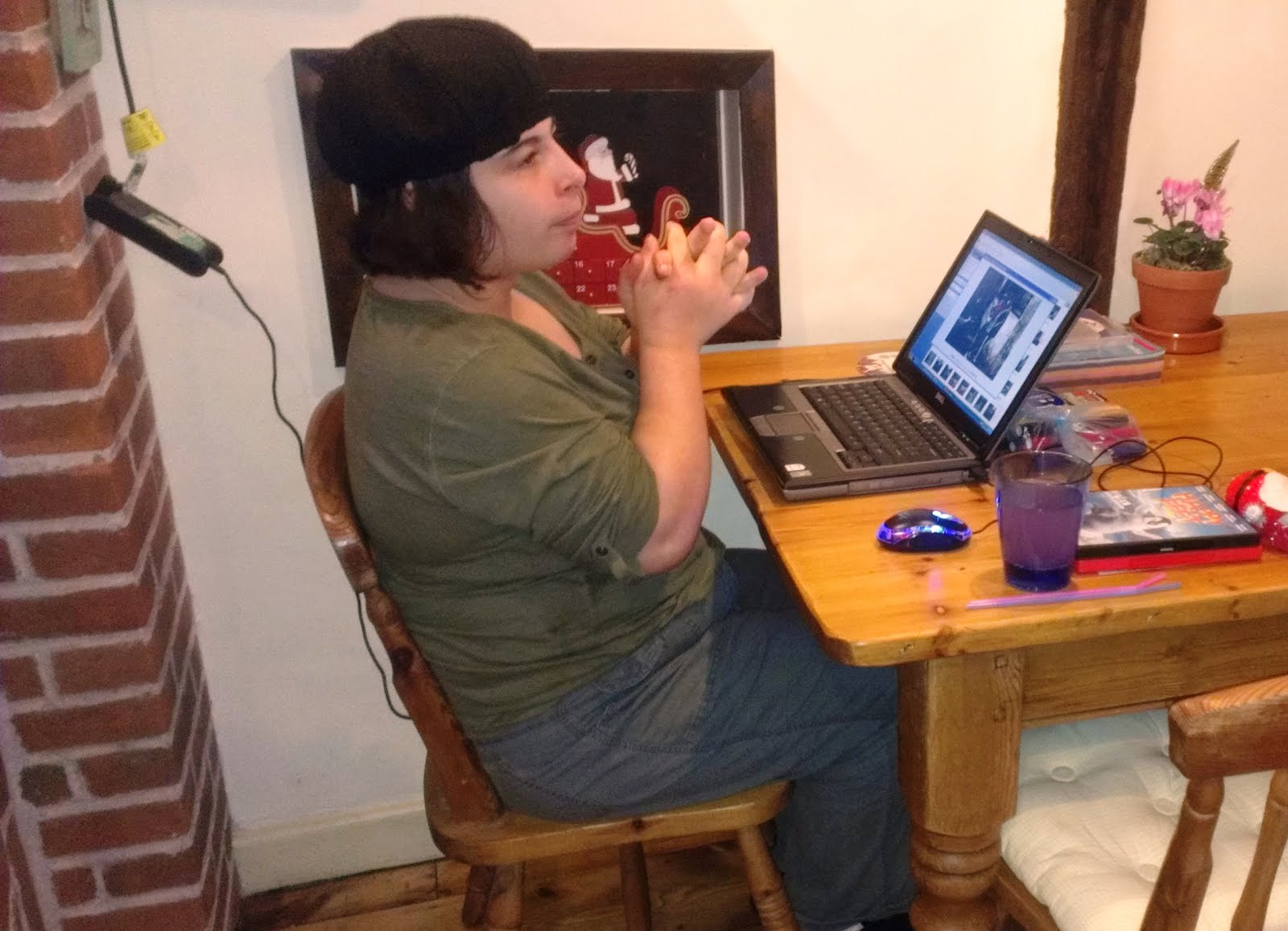
Yesterday, with typical hand-clasp posture, hat on indoors and sleeves rolled up

This question ignited fierce debate when Sally Roberts ran away with her 7-year old son to prevent his radiotherapy cancer treatment for a brain tumour.
http://www.dailymail.co.uk/femail/article-2246877/Sally-Roberts--disappeared-Neon-prevent-having-radiotherapy--talks-ITV-Daybreak.html

However, I believe that Sally Roberts deserves sympathy, not condemnation, especially by ill-informed people online who hadn’t read the whole story. She is obviously frightened & has her son's best interest at heart, even if she may be misguided. Having your child’s life under threat is the most terrifying prospect ever and I can see how it could temporarily unbalance your mind.

I completely understand the need for the courts to step in - parents should have a say in their children's treatment but not necessarily the final decision. I’ve often felt like running away with Chrissy to take charge of her treatment but common sense has prevailed and enabled me to take the longer view. Such an impulsive act could lose me my Deputyship, which means that I’m appointed by the courts to make decisions on Chrissy’s behalf as she lacks capacity to manage her own welfare and affairs. Ultimately, this could leave me powerless to protect her interests in future.

Having said that, I have at times taken a very strong stance over Chrissy’s medical treatment, and it has led to clashes. I know my child’s long, complex medical history better than anyone and always fight her corner if I disagree with her doctors.

I know all too well the feelings of helplessness & desperation when you fear that your child's medical treatment could be doing them more harm than good. Primal instincts take over - I made a rash decision on holiday to stop a treatment that I felt was causing ill-effects – Chrissy's antipsychotic. I held my hands up afterwards & acknowledged that it was a step too far but there had been so many bureaucratic delays over starting the process that I felt desperate. Although her clinicians put her back on the antipsychotic when she returned to the assessment and treatment unit, my actions had the desired effect - although I hadn't done it from a conscious desire to manipulate events. A tapered withdrawal process was started immediately.

Since then, Chrissy has gone from strength to strength. Re-reading my blog post from that holiday, I see that I said Chrissy’s mobility had declined with age – although she’s only 28. I was wrong. Now her meds are sorted out her agility has improved. I’m not sure why, as she's still overweight - maybe she felt dizzy or had vertigo? Her life has been transformed by these long-awaited medication changes. The high levels of self-injury and disrobing that effectively imprisoned her have now reduced so significantly that she is able to go out and about again routinely. As I write this, Chrissy is sitting contentedly next to me turning the pages of her Argos catalogue and pointing out different pictures she likes. Her concentration span and focus have improved no end and she can amuse herself quietly for long periods of time now. Her quirky personality and sense of humour has returned. She laughs, dances and sings again, and notices everything that goes on around her. Last time I blogged about how she was settled enough to cope with a four-hour drive up to Staffordshire to visit her grandma for the first time in around four years.

Chrissy still has her ups and downs, and always will, and her epilepsy is a huge concern, but she is now back to her old self. I can’t emphasise enough how changed she was while on inappropriate medication. She rejected activities that she previously enjoyed, was too unsettled and unfocused to engage in anything for any length of time, and her cognitive abilities and vocabulary had shrunk along with her quality of life. She lost her personality. We thought we had lost her.

What on earth was it like for her? The only way she could express her torment was through violent self-injurious behaviour. There were times that she missed out on weekly visits home because she was so agitated and confused that she didn’t know what was going on, and I couldn’t even get her into my car. This was completely out of character - she looks forward to her home visits all week. Her younger sister even questioned whether her life was worth living at one point because she was suffering such a continual high level of distress. Behaviours included ripping her hair out of her head, leaving her partially bald, breaking her heel by banging it on the floor, gouging and biting her skin until it bled, and sustaining a multitude of bruises, swellings and lacerations all over her body and face through punching, pinching and throwing herself around. She also lashed out at other people, which she only does on occasion when extremely distressed.

Now her hair has grown back and her body is rarely marked from self-injury. Her face has lost its haunted look.

Chrissy can’t express how she feels, and Ian and I often speculate on how she must have felt when she was so distressed on inappropriate medication. There’s nothing worse than watching your child suffer and until you are in a situation like Sally Roberts’s you can’t say what you would or wouldn't do.


I am a SWAN UK (Syndromes without a Name) blogger
MyButton

Wednesday, 5 December 2012

Catching up & Moving on


The last time we'd taken Chrissy to her step-nan's (pictured) was over five years ago. The four-hour journey had been gruelling with a distraught Chrissy repeatedly undoing her seat belt, and screaming, self-injuring and wedging herself into tight spaces.

Last weekend's journey was very different. Apart from the odd burst of repetitive questions, Chrissy settled down in the front seat next to Ian and was content to watch the world go by. When we stopped off at a service station she never once tried to escape to explore the numerous glittering attractions we saw en route to the Ladies. Unheard of!

When we arrived at her nan's Chrissy rushed inside to greet her, grinning from ear to ear. 'I never thought we'd see her like this again,' her nan said, all teary eyed. 'I thought we'd lost her.'

I welled up too as I watched Chrissy taking everything in. She had seen her nan earlier this year when she'd come to stay with us, and she knew who she was. I'm not sure that she recognised the house though. Then her face lit up again as she spotted her sister, Alex, who had come down from Manchester. We hadn't told Chrissy she'd be there or she would have obsessed about it on the way up.


Chrissy is always thrilled to see her siblings. Normally, unless she sees someone regularly she struggles to remember them but she always knows who her younger brother, Jamie, and little sister, Alex, are. The evening went well but Chrissy ate voraciously. We are always trying to distract her and discourage her from overeating but at times, she constantly demands food.

Her happy mood gradually dissipated on Saturday. This often happens after she's been particularly bingey. Something kept coming over her - we never know what - but she suddenly becomes distressed for no discernible reason, and starts screaming, twisting her hands, bending her fingers back and pulling her hair, then she snaps out of it and gives us a beaming smile.

Another mum posted something on a forum that reminded me how difficult things once were for us, and for many other parents of children that have this rare disorder:

''My son's behavioural issues/outbursts/tantrums have escalated so intensely that we don't know what to do anymore. When he gets upset, which is often and for no reason, he is un-calmable. He is incapable of self-soothing, and literally needs me to physically calm him down, rubbing him, deep breathing - sometimes yelling to snap him out of his ritualistic obsessing. It's more than I can take right now and I'm not sure what to do. He woke last night with such emotionally disturbing tantrums and terrors that both my husband and I were in tears......''

Although this desperate mum's description propelled me back to dark times, it also made me realise how far we've come. Chrissy's behaviour will always present challenges to people that look after her but we attribute recent improvements to her revised meds regime. She's still on Prozac but off all antipsychotics. Her behavioural outbursts rarely escalate, her overall mood is much happier, and we can take her out. She continues to be far more alert and engaged in what's going on around her. Her hilarious, stream-of-consciousness observations are back too, giving away all our best-kept secrets! 'Nanny blue jacket, grey hair!' 'You don't like dogs do you mummy?' she declared to my mortification as her nan's adored border collie entered the room. 'Ian farts sometimes,' was another random pearler she uttered loudly and clearly in front of his family. She also threw in a few 'bastard shits' and a couple of 'fucks' for good measure.

The visit was a success, despite Chrissy's changeable mood, and seeing her pleasure at being around loved ones has helped me to re-evaluate what she needs from a supported living placement. I yearn with every fibre of my being to keep her close by where I can protect her and see her more often - but it's not about my needs as a mum - it has to be about what's best for Chrissy. Her psychiatrist and a housing adviser suggested that she'd be better off living in a nearby town. Good public transport links and local amenities would give her more choice of staff and activities, and she wouldn't keep bumping into me while she was out and about. I believe the benefits of living in a community that she's familiar with far outweigh the benefits that are being advocated for her living elsewhere. Chrissy would lead a more fulfilled life if her home was in a familiar place where she has connections to the local community and people that love and care about her. To gain these connections in an unfamiliar place would be a very forced and difficult process for someone that needs 24-hour care and functions at the level of a toddler. Are we in danger of using the 'one size fits all' approach to supported living that is all too often the reason why residential placements break down?

And if it is agreed that Chrissy should live in our village, will government policies dictate otherwise? The current housing and support system is failing many people with a learning disability, who face a lack of housing options due to welfare reforms and budget cuts. Housing benefit caps make rent unaffordable and, although Chrissy can apply for exemption, many private landlords won't accept tenants on benefits, let alone one with a learning disability. Social housing is also inaccessible in some rural areas with specific local connection eligibility criteria. Chrissy wasn't considered for the newly built affordable housing in the village because other applicants that have lived and worked here for years have a stronger local connection. Our only hope is that a suitable, reasonably priced house will come up for sale and a registered landlord will agree to purchase it, and rent it out to Chrissy, possibly in a shared ownership capacity. Struggling to unravel all the supported living red tape makes you wonder if it's delivering on its promise of offering more choice, control and inclusion.

Here, an excellent report by Mencap explores the barriers to successful independent living arrangements, and suggests a national strategy for housing people with a learning disability.
http://www.mencap.org.uk/download-housing-report


I am a SWAN UK (Syndromes without a Name) blogger
MyButton


Sunday, 25 November 2012

Supported Living: Cutting through the Confusion


A supported living option we viewed

We decided some time ago that it would suit Chrissy best to live on her own in the community, with round-the-clock support to help her achieve as much independence as possible - but the choices are mind-boggling and rules about eligibility criteria keep changing. We are just starting down this road and embarking on another steep learning curve!

Here's some information I've gleaned so far, which I've simplified for my own benefit. I hope it helps any of you going down the same road....

Renting privately doesn't work for many people with learning disabilities as standard tenancy agreements only cover a 6 or 12 month period and the landlord can evict the tenant at short notice. It's also unaffordable as most rents now exceed 'local housing allowance' - a term used to describe the maximum amount of housing benefit payable. Another complicating factor is that many people with learning disabilities may need a two-bed house for a carer to stay overnight, or mobility aid adaptations that a landlord wouldn't be prepared to make.

Private sector lease management bypasses some of the obstacles to renting privately. Here, the landlord lets his property to a third party 'Not for Profit' or Registered housing provider that only sublets to disabled tenants. Golden Lane offer a service like this and are affiliated to MENCAP, who would provide the care. Under a private sector leasing arrangement like this, Chrissy's housing benefit claim could then be assessed as exempt accommodation or an excluded tenancy - which means her claim would be excluded from the ordinary rules that cap housing benefit.

In most cases, the only way Chrissy could apply for exemption is if the landlord, or someone acting on his behalf, was prepared to offer a certain amount of care, support or supervision. If she wanted to rent from a private landlord, and care and supervision was independently and wholly commissioned by Social Services, Chrissy could not claim exemption. However if she rented from a registered social landlord, who would contribute to her care and support (I was advised that the amount of support varies but ordinarily around two hours a week) this would fit the bill for exempt accommodation and allow more flexibility on the amount of housing benefit paid.

The care, support and supervision rule deters most private landlords but you would think that it could work for parents if they could afford to buy their child a property to rent from them. Unfortunately, laws governing families renting to disabled relatives are complex and restrictive. A way around the care, support and supervision rule is for Chrissy to rent from a registered housing association. Because the housing association is already regulated by central government and receiving government subsidies it isn't obliged to provide the care and support and it could come from another source. If the housing association don't have anything available they can do a lease deal or buy something outright for Chrissy on the understanding that she would rent it from them.

Our final option, and the one that interests us most, is shared ownership. Chrissy will be on the high rate of DLA for mobility & care again when she leaves hospital, which means she should be eligible to get a small mortgage to be paid for from her benefits. The top-up amount needed to buy something suitable would be paid for by a registered housing association that runs such schemes. They would do all the repairs and maintenance, and it offers Chrissy the most security as she would be a leaseholder. The main drawback for us is that this route is more lengthy and complicated than most, and Chrissy is due to leave the assessment and treatment unit in the next two months.

If we do opt for shared ownership we may have to look at what could be done to support Chrissy here at home with us during the interim period between her discharge and finding a suitable place to live.

Some time in the future we may move to a different area & buy two houses close together with Chrissy in mind. Where we live now is in the middle of nowhere and I've abandoned the idea of her living in the same village. In order to make the most of her independence she will need to be near a town with access to a wide range of amenities and good local transport routes to offer a better choice of staff.

So far we have been offered one option - our local PCT have a vacant bungalow adjacent to two other homes that are singly occupied by women with learning disabilities. They would all be cared for by the same team. The downside of a commissioner providing both housing and care is that the roles would be harder to split if there was a problem say, the care provision failed but the accommodation was fine. This option looks good on the surface, and the bungalow is in a nice area, but I'm uneasy about putting Chrissy completely in the PCT's hands because they've let her down repeatedly in the past. It's also further away from her family home than is preferable.

Another maze to navigate and a big responsibility resting on our shoulders. We need to get it right this time to give Chrissy the life she deserves.


I am a SWAN UK (Syndromes without a Name) blogger
MyButton